Assertiveness as owned aggression
Published 14 May 2026
15 minutes read
Assertiveness is often taught as a communication technique: use calm words, make clear requests, do not blame, do not apologise too much, say no respectfully. These are useful skills, but they are not the root of assertiveness.
At the root, assertiveness is a person’s capacity to own their aggression without letting it become harm.
Aggression here does not mean violence, cruelty or domination. It means the active force that lets a person move towards, stop, refuse, interrupt, challenge, protect, dismantle, leave, repair or transform something. It is the energy of agency. It is the part of us that can say: this matters; this needs to stop; this needs to change; this is not acceptable; this is mine to choose.
Without this force, there is no real boundary. There may be politeness, niceness, compliance, endurance or carefully worded communication, but not a fully inhabited no. A boundary needs enough aggression to hold its edge.
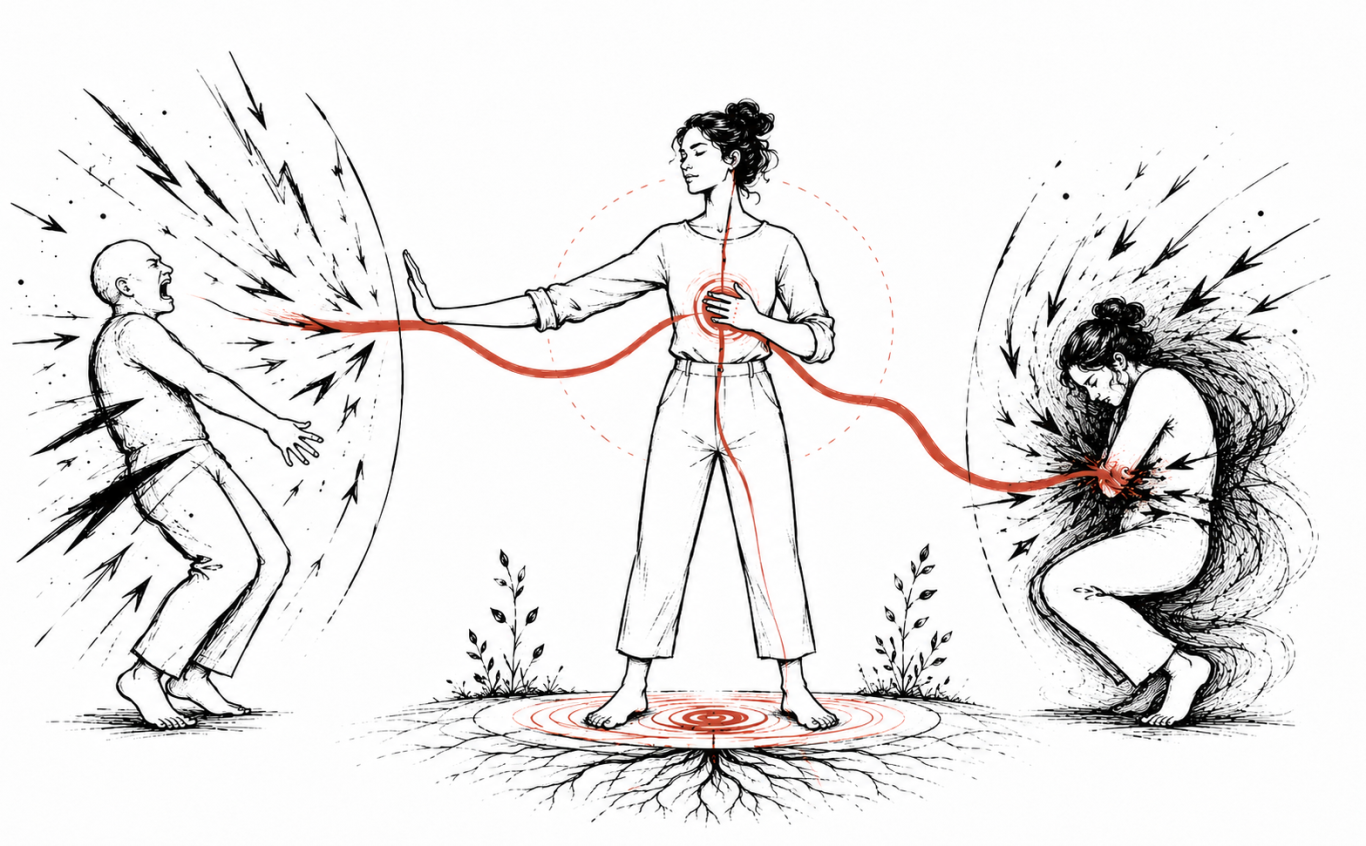
But aggression by itself is not assertiveness. Unowned aggression can injure. It can injure the other person when it moves outward without responsibility. It can injure the self when it moves inward without protection.
Assertiveness begins when aggression becomes conscious enough to be directed rather than discharged.
Aggression is present in all emotional contact
Aggression is easiest to recognise in anger. Anger says: something is wrong; something must stop; something must be challenged, moved or defended against. It gives aggression a target and a vector.
But aggression also appears inside other emotions.
- Interest can contain aggression because it approaches, questions, penetrates and tries to find out what is inside. Therapeutic curiosity, for example, can become useful and precise, but it can also become intrusive if the client experiences the questioning as too sharp, too fast or too exposing.
- Tenderness can contain aggression because it moves towards the other person and may interrupt their current state. A hug, a soothing voice, a comforting touch or an affectionate bid may be loving, but it still changes the other person’s activity and draws them into contact.
- Fear can contain aggression because it heightens sensitivity to threat and may organise control, accusation or avoidance.
- Disgust can contain aggression because it seeks to break contact with what feels toxic, contaminated or unbearable.
- Guilt can contain aggression because it may stop harmful action and push towards repair.
- Shame can contain aggression because it often cuts away some part of the self and tries to hide it from contact.
- Joy can contain aggression because it expands, spills over, takes up space and may accidentally override the room.
- Hope can contain aggression because it may soften, edit or destroy our perception of reality when reality feels too painful.
- Gratitude can contain aggression because it can complete a contact: thank you, that is enough, this exchange can end.
So aggression is not an exception to emotional life. It is woven through emotional life. It is the force of movement, interruption, expansion, refusal, completion and change.
The question is not whether aggression is present. It is always present somewhere.
The question is whether we have agency over it.
The aggressive scenario: when aggression injures the other person
In an aggressive scenario, a person feels activated and moves outward with force. They may be angry, frightened, ashamed, humiliated, desperate to be understood, or convinced that the other person is the problem.
The body prepares for action. The jaw tightens. The chest gathers. The voice sharpens. The attention narrows. The person may feel a strong urge to correct, pursue, expose, persuade, corner, interrupt or make the other person finally see.
There may be a real boundary issue. Something may genuinely need to be named, stopped or challenged. The aggressive energy itself is not the problem.
The problem begins when the person does not recognise the force as theirs.
If aggression is not owned, it is experienced as pure moral certainty: I am only defending myself. I am only telling the truth. I am only trying to help. I am only making a reasonable point. I am only asking for accountability. I am only trying to get through to you.
But the other person may experience the impact very differently.
They may feel invaded, overpowered, shamed, interrogated, trapped, managed, analysed, infantilised or pushed. Their boundary may be violated not because the speaker had bad intentions, but because the speaker’s force had no internal handle.
Unowned aggression often hides inside apparently legitimate forms:
- honesty that becomes cruelty;
- clarity that becomes control;
- care that becomes pressure;
- curiosity that becomes interrogation;
- tenderness that becomes intrusion;
- concern that becomes surveillance;
- hope that becomes denial;
- guilt that becomes a demand for reassurance;
- fear that becomes accusation;
- love that becomes entitlement to access.
The person may still be using calm words. They may even sound reasonable. But if their communication removes the other person’s freedom to think, feel, refuse, pause or disagree, then the interaction is no longer assertive. It has become aggressive.
The injury is not always loud. Sometimes it happens through relentless explanation. Sometimes through emotional urgency. Sometimes through a look. Sometimes through moral pressure. Sometimes through the refusal to stop talking when the other person has clearly reached capacity.
Aggression injures the other person when it stops recognising them as a separate subject.
They become an obstacle, a problem, a witness, a judge, a container, a project, a child, an enemy or a nervous system to discharge into.
Owning aggression interrupts this.
It allows a person to say internally:
This force is mine.
This urgency is mine.
This wish to push, correct, expose or make them understand is mine.
I may have a valid point, but I still have to manage the force with which I bring it.
That inner recognition creates a pause. Not a weak pause. A strong pause. The kind of pause that keeps the force available without letting it become a weapon.
Then assertive speech becomes possible.
Instead of: “You never listen to me.”
We can say: “I am starting to feel more forceful because I do not feel heard. I want to slow down before I begin pushing.”
Instead of: “You are being ridiculous.”
We can say: “I disagree strongly, and I want to stay with the issue rather than attack your character.”
Instead of: “I am only trying to help you.”
We can say: “I want to help, but I need to check whether help is wanted.”
Instead of pursuing someone who is withdrawing, we can say: “I want to continue this conversation, but I can see I am pressing. Are you still available for this?”
The aggression has not disappeared. It has become accountable.
The passive scenario: when aggression injures the self
In the passive scenario, the same force moves inward.
Something happens that violates the person: a demand is too much, a tone is degrading, a request is unreasonable, a pattern is repeating, a boundary is crossed, a relationship is poisoning them, or another person’s responsibility is quietly being handed to them.
Some part of the person knows: no. Stop. This is too much. I do not want this. I cannot carry this. I need to leave. I need to refuse. I need to interrupt the contact.
But if aggression is forbidden, frightening or morally unacceptable, the person may not allow that no to become conscious. They may translate it into something safer.
- I am being selfish.
- I am overreacting.
- I should be more understanding.
- They did not mean it.
- It is not that bad.
- I can cope.
- I do not want to be rude.
- I do not want to hurt them.
- I should be better than this.
Here, aggression does not vanish. It turns against the self.
- Instead of interrupting the harmful contact, the person interrupts their own protest.
- Instead of saying no to the demand, they say no to their own limit.
- Instead of challenging the other person’s behaviour, they challenge their own perception.
- Instead of leaving the toxic situation, they shame themselves for wanting to leave.
This is how passivity becomes self-injury.
From the outside, it may look kind, calm, mature, generous or patient. Internally, the person may be using aggression to dismantle their own boundary.
- They silence disgust.
- They swallow anger.
- They turn fear into compliance.
- They turn guilt into obligation.
- They turn shame into self-erasure.
- They attack their own needs before anyone else can.
This is still boundary violation. The only difference is that now the person participates in violating their own boundary.
This is not weakness. It is often an intelligent survival strategy that was learned in conditions where direct protest was unsafe. Many people have been punished for anger, mocked for sensitivity, ignored when they said no, shamed for having needs, or taught that love means self-abandonment. Their nervous system may have learned that direct assertion risks attachment, while compliance preserves connection.
But the cost is high.
Disowned aggression may become resentment, exhaustion, shutdown, bodily tension, compulsive niceness, emotional numbness, chronic guilt, passive punishment, or sudden disproportionate anger after months or years of suppression.
The person may believe they are avoiding aggression. In reality, they are using aggression against themselves.
They do not become non-aggressive. They become self-aggressive.
Assertiveness becomes possible only when that force can return to the person as legitimate agency.
- Not: I must become harsh.
- Not: I must stop caring.
- Not: I must win.
- But: I need access to the part of me that can stop, refuse, protect and choose.
Assertiveness lives between attack and self-abandonment
Assertiveness is not the absence of aggression. It is agency over aggression.
A person with no access to aggression cannot be fully assertive, because they cannot reliably protect a boundary. They may use the words of assertiveness, but underneath there may be apology, appeasement, collapse or a plea not to be punished.
A person flooded by aggression also cannot be fully assertive, because they cannot reliably respect the other person’s boundary. They may use the words of honesty, justice or clarity, but underneath there may be coercion, pressure or attack.
Assertiveness lives between these two injuries.
- On one side: I will not injure you to protect myself.
- On the other side: I will not injure myself to protect you from my boundary.
This is the ethical centre of assertiveness.
It requires contact with three realities at once:
- our own need;
- the other person’s separateness;
- the actual situation.
- If we lose contact with our own need, we become passive.
- If we lose contact with the other person’s separateness, we become aggressive.
- If we lose contact with the actual situation, we become tangled in hope, shame, fear, guilt or fantasy.
Owning aggression helps us stay oriented. We can feel the force of no without making the other person bad. We can feel the force of wanting without making the other person responsible for satisfying it. We can feel the force of this must change without using humiliation, pressure or threat.
This is why assertiveness is not simply about tone. A soft voice can still manipulate. A calm sentence can still erase. A polite request can still pressure. Equally, a firm voice is not automatically violent. A clear no is not automatically unkind. Conflict is not automatically a failure of care.
- The question is not: Is aggression present?
- The question is: Who is responsible for it?
The two boundary injuries
In the aggressive scenario, we violate the other person’s boundary because we cannot hold our force.
In the passive scenario, we violate our own boundary because we cannot claim our force.
Both are problems of disowned aggression.
In the first, aggression is externalised: you are the problem, therefore I am justified in pushing.
In the second, aggression is internalised: I am the problem, therefore I must push myself harder.
The assertive position is different.
It says:
Something matters here.
I can feel my force.
I will not pretend I have no anger, disgust, refusal, desire or protest.
I will not hand that force over to impulse.
I will use it to speak, choose, stop, repair or leave.
Assertiveness does not require us to become less powerful. It requires us to become more responsible for our power.
Aggression needs a precise job
Aggression becomes dangerous when it has no clear task.
If the task is unclear, aggression sprays. It becomes accusation, pressure, contempt, panic, pleading, collapse, pursuit, self-attack or withdrawal.
Assertiveness gives aggression a precise job.
It asks:
- What needs to stop?
- What needs to be protected?
- What needs to be named?
- What needs to be repaired?
- What needs to be refused?
- What needs to be ended?
- What needs to be changed?
- What belongs to me?
- What does not belong to me?
When aggression has a clear task, it does not need to become theatrical. It does not need to dominate the whole room. It does not need to become a flamethrower when a scalpel would do.
For example:
- If the task is to stop a conversation that is becoming harmful, assertiveness may sound like: “I want to continue this later, but I am not able to do it safely at this intensity.”
- If the task is to refuse a demand, it may sound like: “I cannot agree to that.”
- If the task is to protect time, it may sound like: “I am not available for this today.”
- If the task is to repair, it may sound like: “I regret how I said that. The point still matters, but I do not want to make it through attack.”
- If the task is to challenge without humiliating, it may sound like: “I see this differently, and I want to stay with the behaviour rather than make it about who you are.”
- If the task is to resist self-abandonment, it may sound like: “I can care about your feelings without agreeing to something that harms me.”
These sentences are not magic scripts. They work only when they are backed by an internal shift: aggression has been owned, given a job, and kept inside ethical contact.
The body has to be included
Assertiveness is not only verbal. It is bodily.
If aggression is only held in the jaw, the eyes or the hands, it can become sharp and unsafe. If it is pushed down into the stomach and never allowed to move, it can become nausea, fatigue, resentment or collapse.
Owned aggression needs breath, feet, legs, hips, spine, chest, throat and eyes. It needs support. A person needs to feel that they can stand, breathe and remain present while force moves through them.
This matters because many people lose agency over aggression when their body becomes too activated. They may go into attack, appeasement, freeze, shutdown or frantic explanation. The words may be technically assertive, but the nervous system is no longer in choice.
A useful internal sequence is:
- Feel the feet.
- Let the breath return.
- Notice the jaw and hands.
- Name the force: anger, fear, disgust, guilt, shame, urgency, tenderness, hope.
- Ask what the force is trying to do.
- Give it one clean job.
- Then speak, pause, leave or repair.
This is not about becoming perfectly calm. Many boundaries are set while activated. The aim is not calmness as performance. The aim is enough agency to prevent aggression from becoming injury.
The extra twenty per cent
In conflict, aggression easily escalates. One person sends a charged statement. The other person responds, trying to match the level, but often adds a little extra. The first person receives more than they gave, feels attacked, and responds with their own extra amount.
This is how conflict climbs.
- A criticism becomes an accusation.
- An accusation becomes a character attack.
- A character attack becomes contempt.
- Contempt becomes withdrawal, retaliation or collapse.
Each person may feel they are only responding proportionately. But each adds a small surplus.
Assertiveness requires awareness of this surplus: the extra twenty per cent.
Owning aggression means knowing: when I feel unheard, I add pressure. When I feel ashamed, I become sharp. When I feel afraid, I become controlling. When I feel guilty, I over-explain. When I feel trapped, I withdraw recognition. When I feel small, I try to win.
- Once we know our surplus, we can begin to subtract it.
- Not by becoming passive.
- By becoming precise.
- Precision is aggression with a boundary.
Assertiveness as mature contact
The deepest form of assertiveness is mature contact.
It does not require self-erasure, and it does not permit domination. It allows two separate people to remain separate while something real happens between them.
In mature contact, we do not use the other person as a container for our unmanaged force.
And we do not use ourselves as the dumping ground for everyone else’s comfort.
We can say:
- I am angry, and I am not going to attack you.
- I am hurt, and I am not going to make you responsible for guessing everything I need.
- I feel guilty, and I will check whether repair is needed rather than automatically surrendering my boundary.
- I feel ashamed, and I will not let shame erase me.
- I feel disgust, and I will listen for what contact may need to end or change.
- I feel tenderness, and I will check whether closeness is welcome.
- I feel fear, and I will protect myself without controlling you.
- I want connection, and I will not purchase it with self-abandonment.
- I want distance, and I will not create it through cruelty.
This is assertiveness as emotional responsibility. Not sterile, not robotic, not endlessly calm. Alive, forceful, relational and bounded.
The developmental task
For some people, the developmental task is to stop using aggression as a weapon.
For others, the task is to stop using aggression as a weapon against themselves.
Many people need both.
- The person who attacks may be terrified of helplessness.
- The person who submits may be terrified of becoming dangerous.
- The person who over-explains may be trying to avoid the aggression of a clean no.
- The person who shuts down may be protecting themselves from the aggression of contact.
- The person who rescues may be avoiding the aggression of letting another adult carry their own consequence.
- The person who pleases may be using self-erasure to prevent conflict.
The work is not to shame these strategies. Most of them began as protection. But protection that never develops becomes a prison.
Assertiveness develops when a person can reclaim the aggressive part as a legitimate, bounded part of the self.
- The part that can cut.
- The part that can stop.
- The part that can leave.
- The part that can say no.
- The part that can say yes without resentment.
- The part that can repair without grovelling.
- The part that can challenge without contempt.
- The part that can love without invading.
- The part that can care without disappearing.
Only when we exercise agency over this part do we become assertive.
Not because we have removed aggression.
Because we have taken responsibility for it.
A clean formulation
Aggression without ownership becomes harm.
When it moves outward, it violates the other person’s boundary.
When it moves inward, it violates our own boundary.
Assertiveness is the middle path: owned aggression in the service of contact, protection, truth and repair.
It says:
- I will not hurt you in order to exist.
- I will not erase myself in order to keep you comfortable.
- I will feel the force in me and give it a clean task.
- This stops here.
- This needs to change.
- This is mine.
- This is yours.
- This is where I stand.
That is not aggression avoided.
That is aggression matured into agency.
The information in this article is provided for general psychoeducational purposes only. It is not therapy, clinical advice, diagnosis, or a substitute for working with a qualified professional, and it should not be relied on as such. Any examples are illustrative and may not apply to your individual circumstances. If you are considering making changes to your health, wellbeing, relationships, work, or care, seek appropriate professional support tailored to you.
To the fullest extent permitted by law, we accept no responsibility or liability for any loss, harm, or outcome arising from reliance on the contents of this article. If you are in immediate danger or feel unable to keep yourself safe, contact emergency services or your local crisis support line straight away.
© Olena Baeva 2009-2026