Autistic anxiety: The dread of what will happen again
Published 26 February 2026
What the standard definition gets right, and where it starts to fail
Open almost any mainstream medical text and anxiety is described in familiar terms: apprehension, tension, unease, anticipation of danger, future-oriented threat, misappraisal, overestimation of risk. That model is not nonsense. It is useful, especially for many anxiety disorders.
But for many autistic people, that description can feel like trying to explain a thunderstorm using a smoke alarm manual.
The mismatch matters because language shapes treatment. If distress is framed as irrational anticipation when the person is actually responding to sensory overload, cumulative unpredictability, social processing load, body-based dysregulation, or trauma in a chronically non-accommodating environment, then the intervention can miss the point and make things worse. That is not just a theoretical problem. It is a lived one.
One person said it plainly: “It feels like a biological event with no object.” That is not a bad description of many autistic experiences that get labelled as “anxiety” by default.
Why many autistic people reject the word anxiety for their experience
Autistic people absolutely can experience DSM-style anxiety. The literature supports that. It also increasingly supports something else: many autistic people experience anxiety-like distress that overlaps with standard categories but does not fit neatly into them. Research found both “traditional” and “atypical” anxiety presentations in autistic youth, including substantial overlap and non-DSM-shaped patterns. Another qualitative work with autistic young adults similarly identified both DSM-related and autism-specific presentations, including descriptions of shutting down and meltdown-linked coping.
That is the key distinction. Not “autistic people do not have anxiety”, but “the current anxiety framework is often too blunt”.
Some people describe several forms of distress that standard anxiety language can flatten:
- known, repeated, unavoidable dysregulation in loud, bright, socially demanding environments
- rumination loops that are not always fear-based in the conventional sense
- body-based discomfort, tight chest, agitation, “I can’t stand being in my own skin”
- distress driven by interlocked factors rather than one identifiable trigger
- trauma from repeated invalidation and misattuned treatment, including feeling gaslit
That cluster is clinically important because it changes what “help” should look like.
A new working term carefully: aunxiety
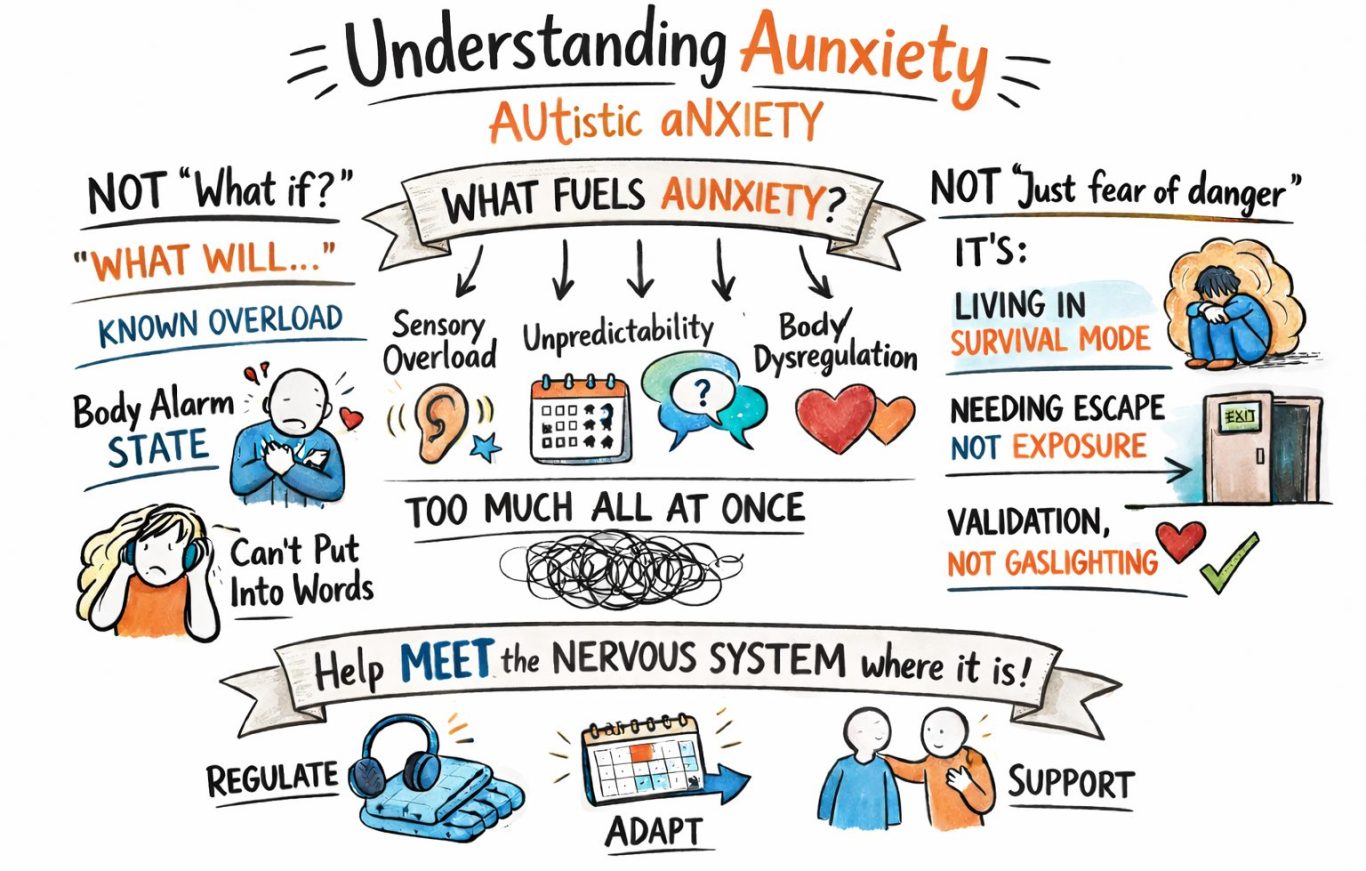
Let me introduce the term and that many people immediately resonated with: aunxiety (AUtistic aNXIETY).
It is a useful public-facing word because it names a difference without denying overlap.
Use it as a working psychoeducational term, not a diagnosis.
That distinction is crucial. Aunxiety is not in the DSM, ICD, or NICE guidance. It is not a substitute for assessing anxiety disorders, trauma, depression, burnout, panic, OCD, dissociation, medical issues, or environmental stress. It is a language tool. A map label. A way of saying, “this may not be adequately described by the default model”.
A practical definition:
- Aunxiety is an autism-linked anxiety-like state in which distress may arise from sensory load, predictability loss, social processing demand, cumulative overwhelm, body-based dysregulation, and trauma-related nervous system activation, sometimes with little or no clear verbalised fear narrative.
That definition stays grounded in current evidence trends while leaving room for individual differences. It also avoids the trap of pretending every autistic person experiences distress in the same way.
What research adds beyond anecdote
The research helps us sort signal from assumption.
1) Presentation can be atypical, not just more intense
Earlier mentioned research found autistic youth could present with traditional anxiety, atypical anxiety, or both. This supports the idea that forcing all distress into standard anxiety categories misses part of the picture.
2) Qualitative accounts matter because lived experience does not always follow textbook logic
Autistic young adults describe both DSM-related and autism-specific anxiety experiences, including “shutting down” and meltdown-linked coping patterns. That matters because public descriptions often over-rely on worry-thoughts and fear of negative evaluation, while autistic distress may be driven by overload, uncertainty, and processing strain.
3) Uncertainty is not a side note
There is a review and meta-analysis that found a robust relationship between intolerance of uncertainty and anxiety in autism, with both anxiety and intolerance of uncertainty elevated in autistic participants across studies. This does not prove one simple cause, but it strongly supports the idea that “threat anticipation” alone is too narrow a lens.
4) Sensory sensitivity and uncertainty can interact
Another research examined links among sensory sensitivity, intolerance of uncertainty, and anxiety in autistic adults. Their work is useful because it supports a more layered model in which sensory processing and uncertainty are not separate planets. They can feed each other.
5) Adult experiences are now being synthesised more explicitly
A 2025 qualitative systematic review highlights autistic adults’ anxiety experiences as both overlapping with and diverging from non-autistic experiences, including cyclical patterns, “othering”, and sensory contributions to both distress and soothing.
That point about soothing is especially important. The same sensory channel can be a trigger in one context and a regulator in another. Human nervous systems are messy, which is very inconvenient for tidy clinical manuals.
Real-life descriptions
“Biological event with no object.”
This captures a body-first experience that many autistic people report. It also helps clinicians stop assuming every distress state begins with a conscious thought chain.
“Dread” for known dysregulation versus “anxiety” for what might happen.
This is a very useful distinction in practice. A loud restaurant, blinding sun, sensory aversion, small talk under strain, and cumulative masking fatigue are often not hypothetical threats. They are recurring, predictable stressors. Calling this “irrational fear” can be invalidating and clinically inaccurate.
“Everything all interlocked and jumbled.”
This maps well onto cumulative load models and the difficulty some autistic children and adults have in pinpointing one cause. The absence of a neat verbal explanation does not mean the distress is vague or imaginary.
“Body-based dysregulation.”
This phrase deserves a place in public education. It is often clearer and less pathologising than asking only about “thoughts” when distress may be predominantly physiological.
What needs caution:
- not all autistic distress is aunxiety
- not all autism-related distress is anxiety-like
- not all “anxiety” interventions are harmful
- not all non-autistic anxiety is cognitive and object-focused
There are autistic people with textbook panic disorder, GAD, social anxiety, OCD, trauma symptoms, or all of the above. There are also non-autistic people with strong somatic, interoceptive, and body-led anxiety presentations. The point is differentiation, not tribal taxonomy.
What philosopher Kierkegaard offers is genuinely interesting. Also slightly dangerous if used too loosely.
In The Concept of Anxiety (often translated with “dread” or “angest”), Kierkegaard is not writing a clinical manual. He is describing a human condition linked to freedom, possibility, responsibility, and the unsettling awareness that we can choose. The Stanford Encyclopaedia summary places his treatment of anxiety squarely in this existential frame.
Why people in autistic spaces may find him resonant:
- he treats “anxiety” as more than fear of a specific object
- he takes lived inward experience seriously
- he allows for diffuse dread that is not reducible to simple threat cues
Why he cannot do the clinical job:
- he is not addressing sensory overload, masking, interoception, trauma, or access barriers
- his framework is philosophical and theological, not neurodevelopmental
- existential language can accidentally romanticise very concrete dysregulation
So yes, Kierkegaard can enrich reflection. He can help widen imagination beyond textbook threat-appraisal models. But if someone is in fluorescent-lit overload and about to shut down, the immediate intervention is not an existential seminar. It is accommodation, regulation, pacing, and getting them out of the sensory blast radius.
Both can be true. Philosophy for meaning. Practical supports for survival.
A public-facing framework that avoids gaslighting
Here is the practical move for clinicians, families, schools, and autistic adults themselves.
Instead of asking only:
“What are you anxious about?”
also ask:
“What is your body doing?”
Chest tightness, skin-crawling, nausea, agitation, frozen feeling, pressure, pain, dissociation, breath changes.
“What is the environment doing?”
Noise, light, heat, smell, crowding, unpredictability, pace, demands, transitions, interruption, social decoding load.
“What is the pattern?”
Is this a “what if” loop, a “what will happen again” certainty, a rumination trap, a shutdown trajectory, or a post-overload crash?
“What makes it worse, and what reliably helps?”
Not what should help in theory. What actually helps in this body.
“What has happened in past support that felt invalidating?”
This matters because treatment itself can become a learned danger cue when people feel disbelieved or pathologised.
If an autistic person is repeatedly told their distress is irrational when it is actually a response to real overwhelm, then therapy can become another source of threat learning. The person may leave not only unsupported, but more dysregulated and less trusting.
That is not “resistance”. That is a predictable outcome of misattunement.
Message for readers: how to tell DSM anxiety and aunxiety apart in real life
This is not a diagnostic test. It is a rough guide.
A more DSM-like anxiety presentation may sound like:
- “I know it is unlikely, but I cannot stop worrying something bad will happen.”
- “I keep anticipating catastrophe.”
- “I am trying to control uncertainty through checking, reassurance, avoidance.”
A more aunxiety-like presentation may sound like:
- “It is not a thought. My body is already in it.”
- “It is not fear of maybe. It is dread of what always happens.”
- “Everything is too much at once and I cannot pick one cause.”
- “I am not overreacting to danger. I am overloaded by reality.”
- “I can talk about thoughts later. Right now I need less input.”
And often, because life is untidy, people will have both.
That is why the question is not “Which category are you?” but “Which process is active right now?”
Aunxiety often isn’t “what if someone harms me?” It is “what will my nervous system do when the world is too loud, too bright, too fast, too unclear?” It is anticipatory fear of predictable dysregulation, not simply fear of hypothetical danger.
Why this matters for treatment, schools, and services
Think about low-intensity services and one-size-fits-all assumptions. The criticism is not that brief therapies are universally useless. It is that services built around narrow assumptions can cause harm when clinicians treat overload as irrationality and exposure as the only answer.
The autism anxiety field is already moving toward more personalised approaches, including frameworks like PAT-A, precisely because standard approaches do not reliably fit everyone. Neurodivergent Insights also translates this distinction into clinician-friendly language, including differences in triggers and states that may resemble anxiety but need different responses.
Luke Beardon’s work is also relevant here, especially for its emphasis on environment and practical reduction of distress in autistic people, rather than treating autism itself as the problem. Even reviews and public summaries of his work repeatedly highlight environmental factors and autistic wellbeing in relation to anxiety.
That does not mean “never use anxiety treatment”. It means start with formulation before protocol.
If the person is in aunxiety, the first intervention may be:
- reducing input
- increasing predictability
- changing the environment
- validating known triggers
- pacing demands
- supporting body regulation
- working with trauma-informed attunement
Not arguing with them about whether their nervous system is “being rational”.
The term we need, and the humility we need with it
Aunxiety is a strong term because it does two jobs at once.
It validates an autistic lived reality that often gets flattened by generic mental health language. And it warns clinicians not to confuse visible distress with a single mechanism.
But the term only helps if we use it with discipline.
- Use it to sharpen formulation, not to shut down assessment.
- Use it to improve validation, not to avoid complexity.
- Use it to distinguish processes, not to build a new box and force everyone into it.
The real win is not the word itself. The real win is better listening.
When an autistic person says, “This is not anxiety in the way you mean,” the correct professional response is not defensive loyalty to the textbook. It is curiosity. Because they may be giving you the missing data.
And that is the whole game, really. Better data, better language, better care. Less gaslighting, more fit.
The nervous system is not a moral failing. Sometimes it is not even a warning. Sometimes it is an overworked control panel in a world designed with the volume too high.
If you want to measure aunxiety rather than just talk about it, use the Anxiety Scale for Autism – Adults (ASA-A), a 20-item self-report questionnaire designed specifically for autistic adults. It asks how often each experience has happened over the past two weeks, with responses on a 4-point scale (Never, Sometimes, Often, Always). For scoring, the guidance is straightforward: code Never = 0, Sometimes = 1, Often = 2, Always = 3, then sum all 20 items for a total score out of 60. You can also calculate three sub-scores (useful clinically for pattern-spotting rather than “labelling”): Social Anxiety (items 2, 4, 5, 10, 12, 14; max 18), Anxious Arousal (items 1, 3, 6, 8, 15, 16, 17, 19, 20; max 27), and Uncertainty (items 7, 9, 11, 13, 18; max 15). A total score of 28 or above may indicate clinically significant anxiety levels.
The information in this article is provided for general psychoeducational purposes only. It is not therapy, clinical advice, diagnosis, or a substitute for working with a qualified professional, and it should not be relied on as such. Any examples are illustrative and may not apply to your individual circumstances. If you are considering making changes to your health, wellbeing, relationships, work, or care, seek appropriate professional support tailored to you.
To the fullest extent permitted by law, we accept no responsibility or liability for any loss, harm, or outcome arising from reliance on the contents of this article. If you are in immediate danger or feel unable to keep yourself safe, contact emergency services or your local crisis support line straight away.
© Olena Baeva 2009-2026