Trust Your Body, Outsmart the Marketing:
Choosing a Therapist
Published 25 February 2026
There is no cheat code for finding “the best” therapist. Anyone promising certainty is selling you comfort, not care.
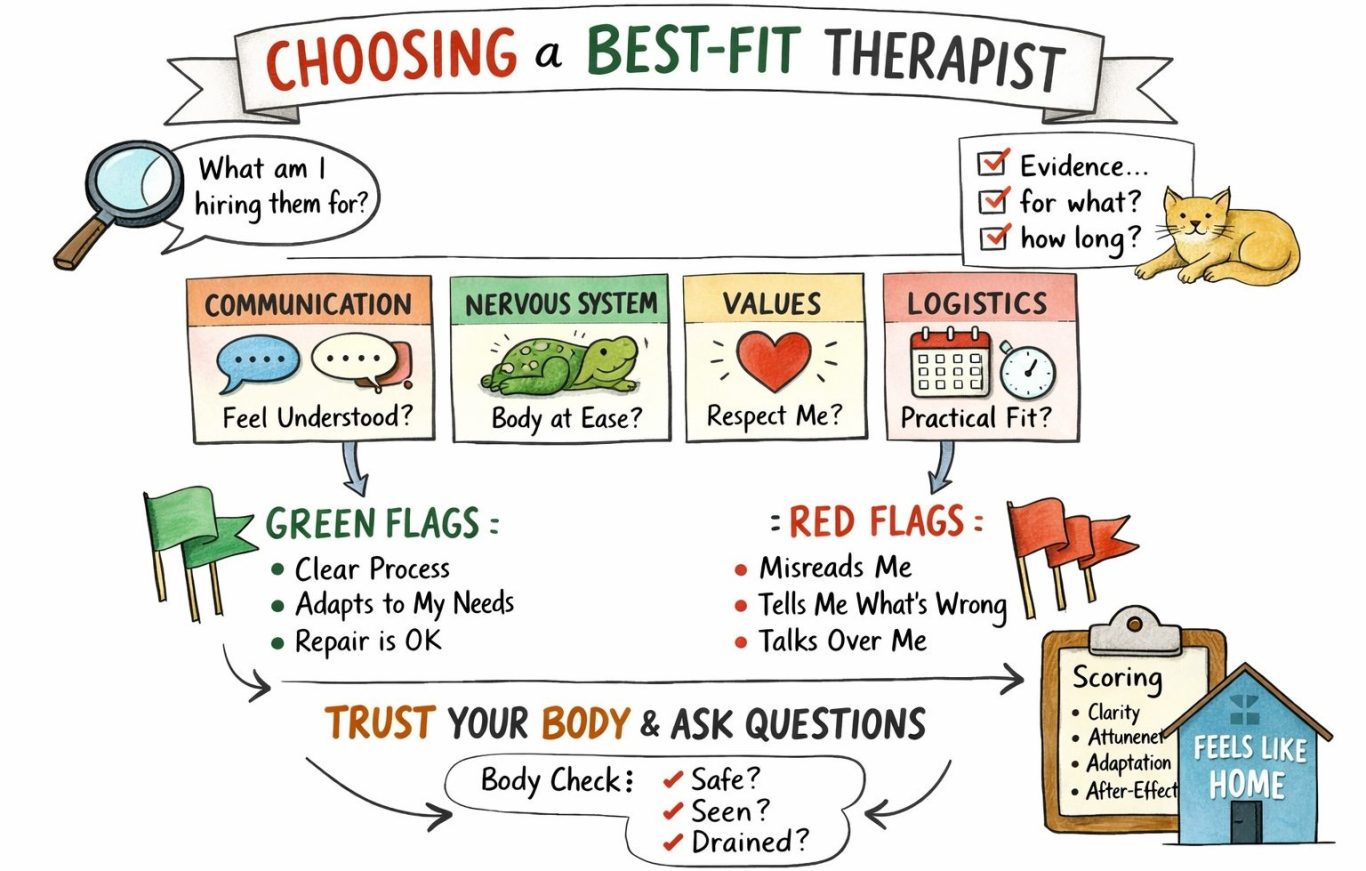
Good news: you can get very good at choosing well, because fit is not mysterious. It is observable. It shows up in your body, in the therapist’s behaviour, and in the tiny details of how the process is run. This article is designed to help you do two things at once: trust your nervous system and outsmart the marketing, with neurodivergent needs firmly in mind.
Therapy is not a product. It is a relationship with a job.
Most purchases are simple: you buy an object, you own it, you move on. Therapy is different. You are hiring a human to do skilled relational work with your mind and nervous system. You cannot separate the “service” from the person providing it.
That is why “nice” is not enough.
A therapist can be warm, experienced, highly trained, and still not be right for you. For neurodivergent clients, mismatch often happens for predictable reasons: differences in communication style, sensory load, predictability needs, and the hidden cost of masking. If therapy repeatedly makes you perform, translate, or brace yourself, it may be “professional”, but it is not safe enough to be useful.
Here is the simplest definition of good fit:
Good-fit therapy feels like you are becoming more you, not more acceptable.
Step one: decide what you are hiring them for (in one sentence)
Before you browse directories, write a one-sentence brief. You are not writing a memoir. You are setting a compass.
Examples:
- “I want help managing overwhelm and recovering from burnout without having to mask harder.”
- “I want to process trauma without spiralling for days afterwards.”
- “I want my relationships to feel safer and less explosive.”
- “I want to understand my patterns and change them, not just analyse them.”
Why bother? Because marketing is designed to pull you into vague hope. Clear intent is your anti-hype vaccine.
A surprising number of people drift into therapy with a foggy “I just want to feel better” and then blame themselves when sessions feel shapeless. That is not a personal failing. It is an input problem. Better input, better outcome.
Fit is not mystical. It is measurable.
Let’s make it satisfyingly unromantic. Fit has four parts:
Fit = Communication + Nervous system + Values + Logistics
If one is off, therapy can still look good on paper and feel awful in practice.
1) Communication fit: do you feel understood without translating yourself?
Neurodivergent communication can be direct, detailed, literal, tangential, slow-to-start, or fast-to-connect. Some people need time before they can speak. Some need precise questions. Some need a therapist who summarises and checks meaning. Some think in systems, not stories.
A good-fit therapist does not treat this as a problem. They treat it as your interface.
Signs of communication fit:
- You do not leave feeling you must rehearse how to speak “correctly” next time.
- They check understanding instead of guessing your meaning.
- You are allowed to be precise, and they do not punish nuance.
- Silence is allowed. Processing time is respected.
- You can correct them without them getting defensive.
If you frequently think, “That’s not what I meant,” and they keep insisting their interpretation is the truth, that is not depth. It is a misunderstanding loop with a power imbalance.
2) Nervous system fit: does your body settle in their presence?
Therapy is not just talking. It is physiology. Your nervous system is the first witness to safety.
For neurodivergent clients, nervous system fit often hinges on sensory load and predictability:
- Lighting, noise, temperature, visual clutter
- Pace of speech, abrupt topic changes, ambiguous questions
- Comfort with stimming, fidgeting, moving, looking away, using a blanket, sipping a drink, taking notes
You are not being “difficult” if you need a space that does not scramble you. You are being practical about access.
A useful rule: If the room makes you brace, your brain has less room to think.
3) Values fit: are they aligned with your autonomy and identity?
Values mismatch can hide behind warmth.
For neurodivergent clients, values fit often includes whether the therapist:
- treats neurodivergence as difference, not defect
- respects self-definition and lived experience
- understands that “functioning” is not the same as “well”
- does not reward masking as progress
- sees behaviour in context, not as a moral failure
Watch for subtle cues. Do they talk about “fixing”, “normalising”, “training”, “appropriate behaviour”, “social skills” as a universal goal? Or do they talk about quality of life, agency, energy, and self-understanding?
4) Logistics fit: does the admin support you or drain you?
This is the underestimated deal-breaker.
If booking, payment, cancellations, reminders, or scheduling make you anxious before you start, therapy begins already taxed. Neurodivergent energy is not infinite. Friction costs matter.
A therapist can be brilliant, but if their system repeatedly destabilises you, that is still part of the service.
The marketing problem: when everyone says “evidence-based”
Here is where you outsmart the sales language without becoming cynical.
“Evidence-based” can mean something real. It can also be used as a prestige badge. The word sounds scientific, so it sells safety. But evidence is never a single thing. It is evidence for a specific outcome, in a specific timeframe, with a specific group, measured in a specific way.
So instead of getting hypnotised by the phrase, translate it into three grounded questions:
1. Evidence for what?
Symptom reduction? Relationship improvement? Trauma recovery? Day-to-day functioning? Self-understanding?
2. Over what timeframe?
Some changes are quick. Others are slow and layered. Short-term studies do not automatically tell you what happens after six months or a year.
3. Does the therapist talk about relationship and process, or only outcomes and techniques?
If a profile reads like a menu of problems they can “treat”, be cautious. If it reads like a thoughtful description of how they work with a person over time, that is often a better sign.
The punchline: Good therapy is not just evidence-driven. It is person-responsive. Evidence matters, and so does fit.
How to read a therapist profile
Most therapist websites are written like polite fog. Some are written like a miracle brochure. Your job is to look for signals.
Look for process language
Green-ish signals include:
- collaboration, goals, feedback, pacing
- clarity about what sessions are like
- mention of adaptation and access needs
- respect for autonomy and consent
- comfort with difference
Be wary of excessive certainty
Caution signals include:
- very confident claims early on
- guaranteed outcomes
- fixed packages presented as universally appropriate
- language that implies the therapist knows “what’s wrong with you” immediately
Certainty can feel soothing when you are overwhelmed. It can also be how you get misunderstood quickly and expensively.
Watch for the “list of everything” problem
Some profiles list twenty conditions, ten methods, and fifteen populations. That can be true. It can also be marketing.
A better sign is specificity:
- “Here is how I adapt sessions for sensory load.”
- “Here is how I work when someone goes into shutdown.”
- “Here is how we’ll know whether this is helping.”
Specificity is competence wearing its normal clothes.
Green flags that matter for neurodivergent clients
These are not vibes. They are behaviours.
Green flag 1: they make the process explicit
They explain what to expect and how you will track progress. They do not leave you guessing the rules.
Examples of helpful language:
- “Here’s how the first sessions usually go.”
- “Here’s what we’ll do if you feel overwhelmed.”
- “If something doesn’t land, I want you to tell me.”
Clarity is not infantilising. It is accessibility.
Green flag 2: they adapt without making it your job
You should not have to teach your therapist how to work with you from scratch.
A good-fit therapist asks practical questions such as:
- “Do you want structure or more open exploration?”
- “Do you prefer direct questions?”
- “Would it help if I summarise and check?”
- “What helps you feel safe enough to think?”
Then they actually follow through.
Green flag 3: misunderstandings are normal and repairable
A strong sign of fit is simple: you can say “no”, “not quite”, or “that’s not it”, and the session improves.
A therapist who cannot tolerate being corrected is a therapist who cannot collaborate. Therapy without collaboration becomes compliance.
Green flag 4: they do not confuse coping with wellbeing
Neurodivergent clients can be excellent at appearing fine.
A good therapist listens for cost. They are interested in what it takes to maintain your life, not just whether you are maintaining it.
Green flag 5: they can hold emotion and practicality
Some clients need space to feel. Some need a plan. Most need both.
A good therapist can be emotionally present without drowning, and practical without being rigid. They can help you make meaning and also help you make Monday easier.
Red flags: when to leave faster than your politeness wants
Neurodivergent people often stay too long out of social obligation, fear of being “difficult”, or hope that they just need to try harder. That can turn therapy into another masking arena.
These are strong reasons to reconsider:
Red flag 1: you are repeatedly misread
You correct them and they keep insisting they know better.
Red flag 2: you feel pressure to perform neurotypicality
Eye contact, tone policing, “calm down”, “just relax”, “you’re overthinking”, “stop being rigid”, or anything that treats your nervous system as a behavioural problem.
Red flag 3: your need for clarity is treated as resistance
Wanting to know what a question means is not control. It is how some brains make safety.
Red flag 4: they dominate the airtime
If they do most of the talking, you may not get enough space to process, especially if you need time to find words.
Red flag 5: you leave consistently worse in a specific way
Therapy can be hard and still helpful. The difference is whether you are moving forward with support, or repeatedly destabilised.
If you leave shut down, ashamed, confused, or dysregulated for days, and this does not improve with pacing adjustments, treat that as serious data.
The consultation: how to do it like a calm adult, even if you feel like a feral hedgehog
A first call is not an audition. It is a compatibility check. You are not trying to impress them. You are trying to observe them.
Ask questions that reveal process, adaptation, and values. Keep it simple.
Questions about process
- “What tends to happen in your first few sessions?”
- “How do we keep track of whether this is helping?”
- “What do you do when therapy isn’t working for someone?”
Questions about adaptation
- “What adjustments do you commonly make for neurodivergent clients?”
- “If I need more directness or structure, can you work that way?”
- “How do you handle misunderstandings in the room?”
Questions about safety and pacing
- “How do you pace work so it doesn’t overwhelm me?”
- “If I get overloaded or shut down, how would we handle that?”
Questions about values
- “What does neurodivergence mean to you in therapy?”
- “What’s your view on masking and unmasking?”
You are listening for:
- specificity, not slogans
- humility, not certainty
- curiosity, not judgement
- collaboration, not control
Trust your nervous system (without letting anxiety run the whole show)
Here is the tricky part. Nervous system signals are real, and they can also be noisy. Past experiences can make safety feel unfamiliar, and unfamiliar can feel unsafe.
So do not rely on one feeling. Rely on patterns.
After any consultation or early session, do a quick “body and brain” debrief:
- Did my body soften at any point, even briefly?
- Did I feel seen, or analysed?
- Did I understand what we were doing?
- Did they adapt to me in real time?
- How did I feel later that day, and the next?
If your body repeatedly says “brace” and the therapist repeatedly says “this is normal resistance”, pay attention to the brace.
A simple scoring system (because feelings are real and also numbers help)
After each early session, rate 0–2 on each:
1. Clarity: did I understand the purpose and direction?
2. Attunement: did they get me without forcing me to translate?
3. Adaptation: did they adjust to my needs and signals?
4. Agency: did I feel more choice, not less?
5. After-effect: useful tired vs wrecked
Score out of 10. Repeat for 3 sessions if possible. Pick the highest.
This is not cold. It is kind. It protects you from staying in something that looks respectable and feels harmful.
What progress often looks like for neurodivergent clients
Progress is not always dramatic. Often it is quieter and more practical:
- You stop rehearsing how to talk.
- You recover faster after stress.
- You notice overwhelm earlier.
- You set boundaries without collapsing into guilt.
- You understand your patterns without hating yourself for having them.
- You build a life that costs less energy to live.
Sometimes progress looks like relief. Sometimes it looks like grief. Often it is both, because unmasking can mean finally noticing how much you have been carrying.
If you are already in therapy and it feels off: try a repair before you run
Leaving is allowed. Trying a repair is also allowed. The key is agency.
Use a simple three-step approach:
1. Name it plainly
“I often leave feeling confused.”
“I need more structure.”
“I feel like I have to perform in here.”
2. Request an adjustment
“Could we start with a brief plan?”
“Could you summarise what you’re hearing and check it with me?”
“Could we slow the pace and focus on one thread?”
3. Watch what happens next
Curiosity and adaptation are green flags. Defensiveness and dismissal are red flags.
This is the grown-up way to test fit. It makes the invisible visible.
The final test: therapy should reduce your masking debt, not increase it
In the outside world, neurodivergent people often survive by paying a daily masking tax. Therapy should not add interest to that debt.
The best-fit therapist helps you tell the truth in your own language, at a pace your nervous system can tolerate, in a relationship where misunderstanding can be repaired.
That combination is rare enough to be worth choosing carefully.
So be choosy. Be practical. Trust your body, and interrogate the marketing. Both are forms of intelligence.
And when you find the right person, therapy stops feeling like you are trying to become someone else. It starts feeling like you are finally allowed to come home.
The information in this article is provided for general psychoeducational purposes only. It is not therapy, clinical advice, diagnosis, or a substitute for working with a qualified professional, and it should not be relied on as such. Any examples are illustrative and may not apply to your individual circumstances. If you are considering making changes to your health, wellbeing, relationships, work, or care, seek appropriate professional support tailored to you.
To the fullest extent permitted by law, we accept no responsibility or liability for any loss, harm, or outcome arising from reliance on the contents of this article. If you are in immediate danger or feel unable to keep yourself safe, contact emergency services or your local crisis support line straight away.
© Olena Baeva 2009-2026