Dissociation and shutdown: when the nervous system says “no more”
Published 25 April 2026 · Approx. 18-minute read
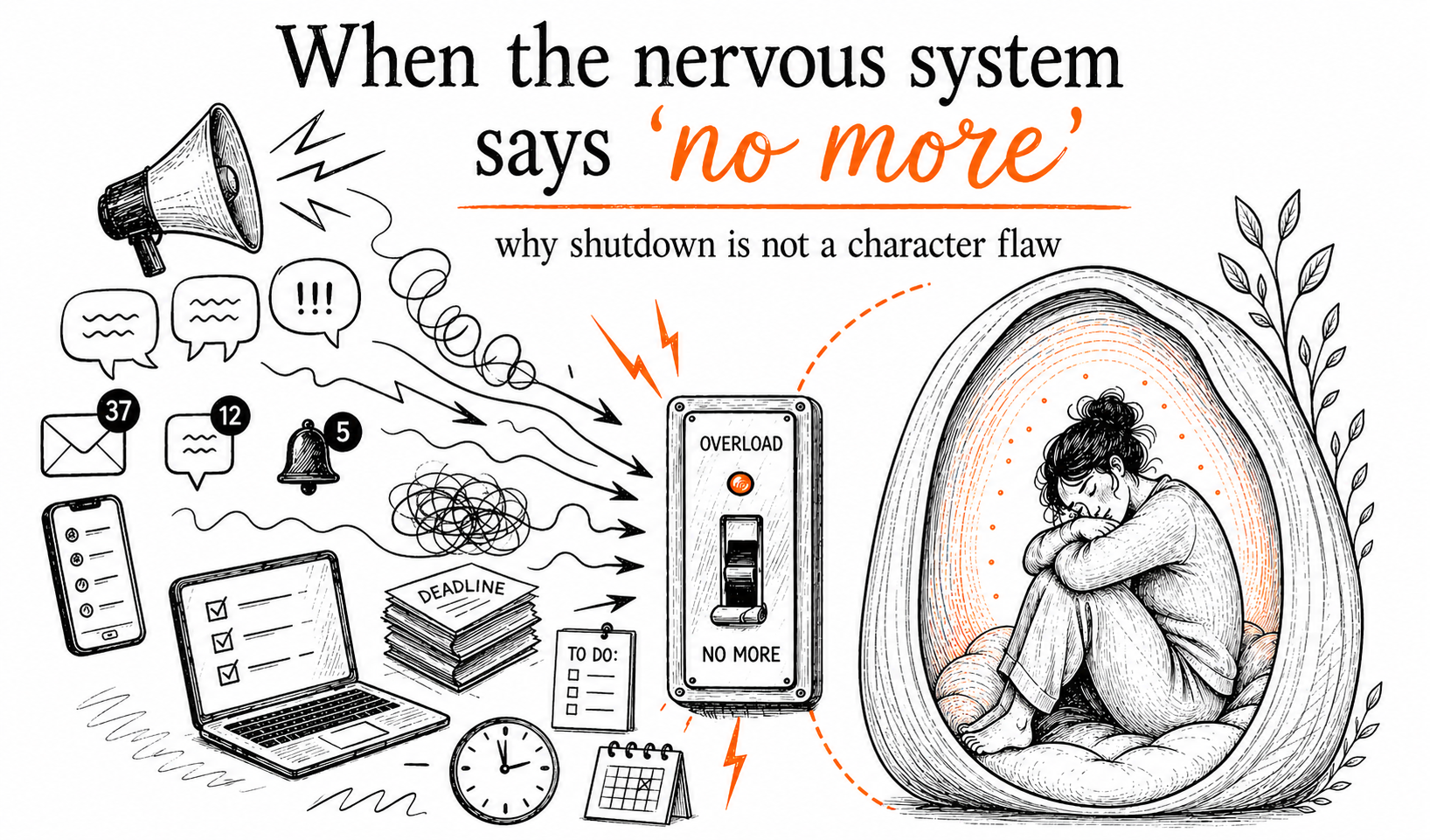
There is a particular moment many people recognise, even if they have never had language for it.
You are not exactly panicking. Panic has movement in it. This is different.
Your mind goes blank. Your words disappear. Your body feels heavy, distant, numb, frozen, or oddly mechanical. The room may seem too bright, too far away, too flat, too loud, or unreal. Someone asks what is wrong and the question feels impossible — not because you are hiding the answer, but because the part of you that normally translates experience into speech has gone offline.
From the outside, it can look like refusal. Sulking. Avoidance. Being difficult. Not trying. Not caring.
From the inside, it can feel more like a fuse has blown.
This article is about that fuse.
More precisely, it is about what happens when the nervous system is pushed beyond its workable margin: when stimulation is too intense, too prolonged, too confusing, too threatening, or the body is already too depleted to keep integrating what is happening.
There is an old physiological idea that helps here: trans-marginal inhibition. There is also a modern body-brain concept that helps us understand what this may feel like from the inside: interoception. And there is a clinical concept that may describe some experiences of going distant, unreal, numb, blank or disconnected: dissociation.
You do not need to know any of these terms to have lived them.
But knowing them can change the story from “What is wrong with me?” to “My system has reached a limit.”
That is not a small change. That is the difference between shame and formulation.
The nervous system does not have an infinite “try harder” setting
Many modern psychological explanations quietly assume that people can keep choosing effort if they are sufficiently motivated. If they stop speaking, stop responding, stop performing, stop engaging, stop coping, or stop appearing emotionally available, the default interpretation often becomes moral: they are avoiding, resisting, being oppositional, being passive-aggressive, or not taking responsibility.
Sometimes people do avoid things. We all dodge what is painful, boring, frightening or inconvenient. But there is another category of experience that is regularly misread as avoidance when it is actually overload.
Deliberate refusal may say: “I have access to the action, but I am choosing not to do it.”
Overload may say: “I cannot currently access the system that would let me do this.”
In real life, the distinction is not always tidy. Avoidance, fear, exhaustion and overload can coexist. The point is not to infer capacity simply from what the behaviour looks like from outside.
Those are not the same state. They may look similar from the outside, especially to a teacher, partner, parent, manager, clinician or friend who wants a response. But the internal mechanism is different.
The nervous system is not a motivational poster. It is a living, energy-limited, body-based regulatory system. It can mobilise, adapt, compensate, mask, perform, suppress, override and endure. But not indefinitely. At some point, increasing input may stop producing increased performance and instead produce reduced responsiveness. Pavlov described this pattern as protective inhibition.
The system does not keep climbing forever. It cuts power.
Pavlov’s “beyond-the-limit” inhibition
The term trans-marginal inhibition comes from Pavlovian physiology. In Russian sources, it is usually described as запредельное торможение, literally “beyond-the-limit inhibition”, and also as охранительное торможение, or “protective inhibition”. Russian physiology teaching texts describe it as inhibition that appears when a stimulus becomes too strong, too long-lasting, or too much for the current working capacity of the nervous system, with a protective function for nerve cells (Russian physiology text; Russian encyclopaedic definition).
The basic idea is simple and still clinically useful:
In Pavlov’s model, stimulation beyond the organism’s working capacity could produce inhibition rather than continued responding.
This was not originally a theory about laziness, personality, attitude or willpower. It came from experiments on conditioned reflexes and nervous-system functioning. Pavlov described nervous-system differences in terms of the strength, balance and mobility of excitation and inhibition, and noted that organisms differ in how well their nervous systems can tolerate strain (Pavlov’s Russian text on types of higher nervous activity). In his English lectures, Pavlov was also careful about over-simplification: he described excitation and inhibition as deeply interwoven and warned against easy analogies in such a complex system (Pavlov, Lecture XXII).
The “margin” in trans-marginal inhibition is not a moral threshold. It is not a test of character. It is the functional limit of what the nervous system can process, tolerate and integrate at that moment.
A caution is necessary here. Pavlov's account came largely from conditioned-reflex research and belongs to an earlier model of nervous-system physiology. I use trans-marginal inhibition here as a historical framework for thinking about what happens when increasing stimulation begins to produce reduced rather than increased responding — not as evidence that autistic shutdown or dissociation has been shown to be Pavlovian protective inhibition.
A person’s limit is not fixed. The same demand can be manageable on Monday and impossible on Friday. The same conversation can be tolerable after sleep and unbearable after weeks of masking. The same supermarket can be fine when rested and catastrophic when hungry, ill, hormonal, grieving, sensory-loaded, or already near the edge.
The stimulus is not only the stimulus. It is the stimulus plus the state of the organism receiving it.
- A sound is not just a sound when you are sleep-deprived.
- A text message is not just a text message when you are burnt out.
- A question is not just a question when your body is already scanning for threat.
- A light is not just a light when your sensory system has no filter left.
This is why the phrase “but it was only…” can be so cruel. “It was only a meeting.” “It was only a joke.” “It was only a phone call.” “It was only a small change.” “It was only a bit of noise.”
Nothing is “only” anything when the margin has already been used up.
Pavlov's language and proposed cortical mechanism belong to an earlier era of neuroscience, but the broader observation that defensive responding does not simply increase in proportion to stimulation has not disappeared. Contemporary defence neuroscience distinguishes between active responses, such as fight and flight, and passive responses, including immobility and reduced responsiveness. These responses involve partly distinct circuits within the midbrain periaqueductal grey (PAG), and appear to depend not only on the intensity of threat but on factors such as its imminence, controllability and the possibility of escape.
There is an interesting historical convergence here. Pavlov described both a passive self-preservation response to powerful stimulation and a “paradoxical” phase in which stronger conditioned stimuli could produce weaker responses than less intense stimuli. Modern PAG research should not be treated as proof of Pavlov's proposed mechanism, but both bodies of work challenge the intuitive assumption that more threat must always produce more visible response. Under some conditions, increasing threat is associated instead with a transition from mobilisation towards inhibition, immobility or reduced behavioural output.
Too much can mean too intense — or too long
When people imagine overwhelm, they often imagine something dramatic: an explosion, a car crash, a public humiliation, an argument, a panic attack, a terrible piece of news.
Yes, intensity can push the system beyond its margin.
But duration matters too.
A moderately stressful situation that goes on for too long can become biologically excessive. A manageable demand repeated without recovery can become unmanageable. A sensory irritation that looks minor to someone else can become unbearable after hours. A social performance that is possible for one meeting can become impossible after years of masking.
This is vital for understanding trauma, autism, ADHD, burnout, parenting stress, caring labour, chronic illness, relational conflict and poverty. The nervous system may not collapse because of one huge thing. It may collapse because of too many “small” things with no genuine restoration.
Drip. Drip. Drip. Drip.
Then one day the cup is not just full. It has no cup left.
The National Autistic Society describes autistic fatigue and burnout as arising when pressures become too much, noting that managing sensory overload and navigating social situations can consume enormous energy just to get through an average day (National Autistic Society: autistic fatigue and burnout). That is a modern everyday version of an old physiological principle: when capacity is already reduced, ordinary input can become beyond-the-limit input.
None of this means people have no responsibility for repair, communication or practical adaptation. It means responsibility has to begin with an accurate account of capacity.
You cannot build accountability on a false model of the nervous system.
Interoception: the body’s internal sense
Now we need a second concept: interoception.
Interoception concerns the sensing and processing of signals arising from within the body. It includes heartbeat, breathing, hunger, thirst, nausea, temperature, pain, muscle tension, bladder and bowel signals, sexual arousal, fatigue, internal agitation, and the bodily roots of emotion. Neuroscience papers often define it as the sensing, signalling and mental representation of internal bodily states (Garfinkel et al., 2015; Critchley & Garfinkel, 2017).
Interoceptive information contributes to questions such as:
- Am I safe?
- Am I hungry?
- Am I in pain?
- Am I too hot?
- Am I about to cry?
- Am I angry?
- Am I overloaded?
- Do I need to move, hide, eat, sleep, speak, stop, leave, or ask for help?
Interoception is not just “noticing sensations”. It is also interpreting them. Garfinkel and colleagues separated interoception into different dimensions: objective accuracy, subjective sensibility, and metacognitive awareness of how accurate one is (Garfinkel et al., 2015). That distinction is important because two people may both feel a racing heart, but relate to it very differently. One interprets it as excitement. Another interprets it as danger. Another notices the sensation but has no idea what it means. Another does not notice it until they are already shaking.
This is one reason emotional language can become complicated. We often talk as if emotions arrive neatly labelled: anger, sadness, shame, fear, joy. In reality, the brain is often making meaning from body data, context, memory, expectation and social cues.
If internal body signals are confusing, faint, overwhelming, contradictory or difficult to trust, emotional self-understanding can become harder. A 2024 systematic review and meta-analysis found that alexithymia — difficulty identifying and describing emotions — is associated with several subjective interoceptive patterns, including interoceptive confusion, heightened attention to bodily sensations, and lower interoceptive trusting or self-regulation, depending on the measure used (Van Bael et al., 2024).
A person may say, “I do not know what I feel.”
They may not be being evasive. They may be telling the truth.
Or they may say, “I was fine, then suddenly I exploded.”
But perhaps the body was signalling distress for hours, and the signal never reached conscious interpretation until it became extreme.
Or they may say, “I know something is wrong, but I cannot find it.”
That can be interoceptive uncertainty: the body is sending weather, but the map is blurred.
Dissociation: when integration goes patchy
The third concept is dissociation.
Dissociation is often misunderstood. People may associate it only with severe trauma or with dramatic portrayals of identity fragmentation. Those experiences exist, but dissociation is broader than that.
At its simplest, dissociation involves disruption in the normal integration of consciousness, memory, perception, emotion, identity, body awareness or action. The American Psychiatric Association describes dissociative disorders as involving problems with memory, identity, emotion, perception, behaviour and sense of self, including experiences of detachment or feeling outside one’s body (American Psychiatric Association).
Shutdown and dissociation can overlap, but I do not use the terms as synonyms. An autistic shutdown may involve reduced speech, movement, decision-making or social responsiveness without necessarily involving depersonalisation, derealisation, amnesia or a disrupted sense of self. For some people, however, shutdown also includes dissociative experiences such as unreality, disembodiment, emotional disconnection or feeling absent. Research into the relationship between these experiences is still limited.
In real life, it may sound like this:
- “I feel like I am watching myself from far away.”
- “My body does not feel like mine.”
- “The world looks unreal.”
- “I went blank.”
- “I could hear them but could not process the words.”
- “I was there, but I was not there.”
- “I could not speak.”
- “I felt numb.”
- “I lost time.”
- “I did what I was told but felt absent.”
- “I could not move.”
- “I felt like I was behind glass.”
Dissociative experiences can occur in many contexts, including trauma and severe stress, panic, pain, exhaustion and some medical situations. People also report dissociative experiences during sensory or relational overload, although the mechanisms and boundaries between these states are not always clear.
The key word is integration.
Ordinarily, experience depends on integration across body signals, external sensory information, memory, movement, language, emotion, time, self, other people, meaning and choice.
When integration is working, you feel like a person in a body in a room in the present moment.
When integration falters, you may feel like a mind without a body, a body without a self, a person behind glass, or a machine carrying out instructions.
This is not melodrama. This is what it can feel like when the nervous system’s stitching starts to come undone.
A note on assessment: experiences such as loss of awareness, significant memory gaps, new episodes of immobility or inability to speak, seizure-like events, or marked changes in vision or consciousness should not automatically be attributed to dissociation or autistic shutdown. Similar experiences can have neurological, cardiovascular, medication-related and other medical causes, so new, severe or unexplained episodes warrant appropriate medical assessment.
The bridge: a possible formulation of overload, interoception and dissociation
Here is where the three ideas meet.
Pavlov's trans-marginal inhibition model proposes that when stimulation exceeds the organism's workable margin, inhibitory responding may increase rather than the response simply continuing to intensify.
Interoception concerns the brain's ongoing sensing and processing of internal bodily signals.
Dissociation involves disruption in the integration of body, self, perception, memory, emotion or action.
A 2026 systematic review in Neuroscience & Biobehavioral Reviews specifically examined interoception and dissociation, asking whether altered interoceptive processing may be involved in dissociative experiences (McDonald, Sleight, Mattson & Fani, 2026). The authors found a promising but still limited and heterogeneous evidence base: only a small number of studies met inclusion criteria, and most found at least one significant interoceptive difference related to dissociation, but the field is not yet clean enough to support a single simple pathway.
That caution is important.
This idea is also compatible with a 2022 computational model of depersonalisation disorder, which proposed that, in inescapable threat-like conditions, the system may downregulate interoceptive signals — an “interoceptive silencing” mechanism — leaving the person over-reliant on external sensory information and feeling detached from body and self (Saini et al., 2022).
But again: not too tidy. A 2014 study on depersonalisation-derealisation disorder found that people could have overwhelming experiences of disembodiment despite normal interoceptive accuracy on a heartbeat task (Michal et al., 2014). That means dissociation is not simply “poor interoception”. It may be about disrupted body ownership, meaning, prediction, integration, trust, or access — not just detection.
So the careful version is this:
The evidence does not yet establish one pathway connecting overload, interoception and dissociation. But these three bodies of work allow a clinically useful hypothesis.
When internal, external or relational load exceeds current capacity, responsiveness may reduce. In some people, that state may also involve altered integration of bodily signals, self, perception, emotion or action. When it does, the lived experience may include dissociative features such as numbness, unreality, disembodiment or absence.
This should be understood as a working formulation rather than a demonstrated sequence from overload to dissociation.
That is strong enough to matter, and humble enough to be honest.
Pain can go quiet too: stress-induced analgesia
One of the clearest examples of the nervous system editing body-signals is stress-induced analgesia, of which fear-induced analgesia is one experimentally studied form. Many people have had some version of this experience: you cut yourself, fall, get injured, or go through an emergency, and only later — when you are safe — does the pain fully arrive.
This is not because the injury was not real. It is because, under acute threat, pain may temporarily become less useful than survival.
If the body needs to run, fight, freeze, protect someone, get out of danger, or keep functioning through an immediate crisis, the nervous system may dampen pain-signals. In survival terms, this makes sense: move now, feel later. Pain asks for attention, care and protection. But in the middle of danger, too much pain can slow action. So the brain and body can turn the volume down.
This matters because it gives us a familiar doorway into understanding shutdown and dissociation.
The body is not a neutral live-stream. It does not simply report everything accurately and evenly. It prioritises. It filters. It gates signals according to threat, context, capacity and survival need. Under one kind of pressure, pain may go quiet. Under another, hunger may disappear. Under another, speech may vanish. Under another, the person may feel unreal, numb, distant or unable to move.
Fear-based analgesia is not the same as dissociation or autistic shutdown. What it demonstrates more modestly is that access to bodily information is state-dependent: under some conditions the nervous system can substantially alter the salience of a signal that would normally dominate awareness. That makes it a useful analogy, not proof of a common mechanism.
There is an important nuance. Fear and stress do not always numb pain. Acute, intense threat may dampen pain, while chronic stress, uncertainty, anxiety and trauma can also make pain louder, sharper or more persistent. The nervous system can turn signals down, but it can also turn them up. Both are protective attempts, depending on what the system predicts is needed.
So fear-based analgesia strengthens the central point of this article: shutdown is not simply “not trying”. Dissociation is not simply “being dramatic”. Numbness is not always absence. Sometimes numbness is an active survival state.
- Pain can go quiet.
- Speech can go quiet.
- Emotion can go quiet.
- Presence can go quiet.
Not because the person is empty, careless or weak — but because the nervous system has crossed a threshold where ordinary access has become too costly.
Why autistic people may recognise this strongly
Autistic people often live with sensory, social and cognitive demands, alongside sometimes complex interoceptive experiences that are underestimated by others.
A room is not just a room. It may be a grid of lights, hums, smells, textures, unpredictable bodies, social decoding, temperature changes, background speech, movement in peripheral vision, pressure to perform facial expressions, and the constant need to decide what is relevant.
A conversation is not just a conversation. It may involve tone analysis, timing, facial processing, implied meaning, interruption management, eye-contact decisions, body-position monitoring, emotional labour, and the risk of being misunderstood.
A workday is not just a workday. It may involve transitions, task switching, masking, sensory suppression, executive-function load, ambiguous expectations, and recovery debt.
From outside, the person may look “fine”.
Inside, they may be running a whole control room manually.
The National Autistic Society describes sensory overload as taking in too much sensory information and being unable to process any more; autistic people themselves report signs such as not speaking, appearing disengaged or “closed off”, difficulty focusing, stimming, pacing, rocking, hiding, crying, resisting touch, or running away (National Autistic Society: sensory processing). Leicestershire Partnership NHS Trust similarly describes autistic shutdown as a freeze-like response, often caused by sensory overload and similar triggers to meltdowns, including social situations, unpredictability, basic needs such as hunger or pain, and emotional situations (Leicestershire Partnership NHS Trust).
An Autism Society guide for healthcare professionals describes autistic shutdown as withdrawal, unresponsiveness or disengagement in response to overwhelm, calling it a protective mechanism to conserve energy during intense stress (Autism Society, 2025 guide). Autistic-led writing from Reframing Autism also frames shutdown as a coping mechanism triggered by overload, emotional demand, exhaustion, sudden change, stress or a succession of smaller distressing incidents, and explicitly names the mismatch between individual needs and environment (Reframing Autism).
That is the lived-practical translation of the theory: when load exceeds capacity, the person may not become louder. They may disappear inward.
Research on autism and interoception is more mixed than popular posts sometimes suggest. A 2025 systematic review and meta-analysis found no clear systematic difference in cardiac interoceptive accuracy between autistic adults and non-autistic controls in the small group of comparable studies, while other interoceptive dimensions showed inconsistent findings (Klein, Witthöft & Jungmann, 2025). In plain English: autistic interoception is not “always poor”. It is variable, context-dependent and measurement-dependent.
That actually fits clinical reality better.
Some autistic people notice body signals intensely. Some do not notice them until they are extreme. Some feel sensations but cannot interpret them. Some interpret them accurately in calm conditions but lose access under social or sensory demand. Some are painfully aware of everything and still cannot translate it into a socially acceptable sentence quickly enough.
This is why autistic shutdown can be so badly misread. The person may stop speaking, withdraw, become still, appear cold, avoid eye contact, lose facial expression, or need to leave. If the observer uses a moral lens, they may see rudeness or non-compliance. If they use a nervous-system lens, they may see load exceeding integration capacity.
Emerging peer-reviewed research now supports many of these first-person descriptions. In a participatory qualitative study of autistic adults, shutdown was described through experiences of freezing, cognitive “crashing”, retreating inward, being unable to keep up and entering a survival-like state. Participants described reduced access to speech, movement, decision-making, emotion and agency; some also described dissociative experiences. The evidence base remains small, but importantly it is beginning to centre autistic descriptions of the phenomenon itself.
When shutdown is misread as deliberate or strategic behaviour, people often increase the very demands that contributed to it
When shutdown is misread as behaviour, people often increase the very demands that caused the shutdown.
- They ask more questions.
- They move closer.
- They insist on eye contact.
- They demand verbal explanation.
- They add consequences.
- They interpret delay as disrespect.
- They say, “Use your words.”
- They say, “You need to take responsibility.”
- They say, “Don’t walk away from me.”
- They say, “This is manipulative.”
Sometimes they mean well. They may be frightened, hurt, confused, or trying to maintain a boundary. But if the person is already overloaded or shutting down, additional relational pressure may deepen the shutdown.
- You cannot force integration by increasing threat.
- You cannot demand speech from a nervous system that has lost access to speech.
- You cannot punish someone back into embodiment.
This does not mean anything goes. It does not mean people get to harm others and call it overload. It means the intervention has to match the state.
When someone is within their workable margin, conversation, reflection, repair, accountability and planning may be possible.
When overload appears to be the problem and immediate safety or medical needs have been considered, a useful first response is often load reduction.
Not a lecture. Not interrogation. Not moral analysis. Load reduction.
What helps when the system is past its margin
The first question is not “Why are you being like this?”
A useful first question may be: “What load can be reduced now?”
That may mean less speech. Fewer questions. More space. Lower light. Reduced noise. A predictable exit. A written option instead of a verbal one. Food. Water. Warmth. A blanket. A change of clothing. A quiet room. A familiar object. Pressure through the body. Time without performance.
For some people, grounding through the body helps. For others, direct body-focus is too much. Telling someone to close their eyes and notice their heartbeat can be calming for one person and destabilising for another. If interoceptive signals are already overwhelming, confusing or associated with panic, body-scanning may feel like being asked to stare directly into the alarm.
This is why consent matters.
A safer menu might sound like:
- “Would it help if I stopped talking for a bit?”
- “Do you want light, pressure, movement, water, or space?”
- “Do you want me nearby or further away?”
- “Would typing be easier than speaking?”
- “Do you need a pause before we continue?”
- “We do not have to solve this while your system is overloaded.”
That last sentence can itself reduce load.
Not because it fixes everything, but because it removes the demand to perform insight while the brain is struggling to remain integrated.
Coming back is not the same as being dragged back
There is a difference between supporting someone back into presence and dragging them back because their shutdown is inconvenient.
Dragging sounds like: “Look at me. Answer me. Stop doing this. You’re fine. This is ridiculous. We need to talk now.”
Supporting sounds like: “You seem overloaded. I’m going to stop asking questions for a while and give you some space unless you indicate otherwise. We can come back to this later.”
The goal is not to make the person appear normal as quickly as possible. The goal is to help the nervous system return to a workable range safely enough that language, choice, emotion and relational repair become available again.
For some people, recovery after severe overload may take much longer. Needing recovery time should not automatically be interpreted as laziness or unwillingness.
A nervous system that has crossed its margin does not bounce back because someone else is impatient.
A better story about shutdown
The most compassionate explanations are not the softest ones. They are the most accurate ones.
Understanding shutdown as a limit-state does not romanticise it. It does not make it pleasant, harmless or easy for other people. It simply asks us not to assume that reduced speech, movement or responsiveness necessarily represents unwillingness or deliberate non-compliance.
- Not automatically moral failure.
- Not automatically lack of effort.
- Not necessarily attention-seeking.
- Not weakness.
- A possible limit-state in which load has exceeded currently available capacity.
- A state in which access to speech, movement, emotion, decision-making or social response may narrow.
That understanding changes what we do next.
- Instead of asking, “How do I make this person comply?” we ask, “What has exceeded capacity?”
- Instead of asking, “Why won’t they talk?” we ask, “What would make speech accessible again?”
- Instead of asking, “Why are they so dramatic?” we ask, “What signal has been ignored until it became extreme?”
- Instead of asking, “Why can’t they cope with normal things?” we ask, “What makes this supposedly normal thing neurologically expensive for this nervous system?”
That is not letting people off the hook. It is finding the hook. The real one.
Because if we misname overload as attitude, we will prescribe pressure.
And pressure is exactly what a beyond-the-limit system cannot use.
The simplest formulation
If you take one idea from this article, let it be this:
The nervous system does not have an infinite capacity for stimulation, demand or emotional threat. When load exceeds the current margin, access may narrow: less speech, less movement, less feeling, less presence, less capacity to respond.
A nervous system under greater threat does not necessarily produce more behaviour. Sometimes the defensive organisation itself changes.
- From the outside, that can look like refusal.
- From the inside, it may feel like disappearance.
- The work is not to shame the person back into the room.
- The work is to reduce enough load for return to become possible.
The information in this article is provided for general psychoeducational purposes only. It is not therapy, clinical advice, diagnosis, or a substitute for working with a qualified professional, and it should not be relied on as such. Any examples are illustrative and may not apply to your individual circumstances. If you are considering making changes to your health, wellbeing, relationships, work, or care, seek appropriate professional support tailored to you.
To the fullest extent permitted by law, we accept no responsibility or liability for any loss, harm, or outcome arising from reliance on the contents of this article. If you are in immediate danger or feel unable to keep yourself safe, contact emergency services or your local crisis support line straight away.