Deep focus vs rapid switching: understanding monotropism
Published 16 February 2026 · Approx. 12-minute read
What “monotropism” is
Modern life is engineered like a slot machine for your attention. Messages, pings, quick questions, shifting priorities, tabs inside tabs, and the subtle social rule that you should be able to pivot instantly and pleasantly.
That works better for some nervous systems than others.
Monotropism is an attention-based theory that suggests that some people tend to allocate attention narrowly and intensely to a small number of interests or demands at a time, while others distribute attention more broadly across several things. It was developed by Dinah Murray, Mike Lesser and Wenn Lawson as an attention-based account of autistic cognition and is now widely discussed within neurodivergent communities. Monotropic traits are not exclusive to autism: the 2023 Monotropism Questionnaire study found that both autism and ADHD status were independently associated with higher monotropism scores, with the highest mean scores among autistic participants who also had ADHD.
The point is not to sort people into better and worse brains. The point is to understand attention as a limited resource.
Monotropism is best understood as an autistic-developed explanatory theory rather than a settled neurological mechanism. It has strong resonance in autistic accounts and growing research interest, but empirical testing is still relatively limited and results are not uniformly convergent.
If you have ever felt “locked in” to something, for better or worse, or felt a flash of irritation when interrupted, monotropism offers a simple and compassionate explanation: attention does not just move. It transitions.
The flower in your mind
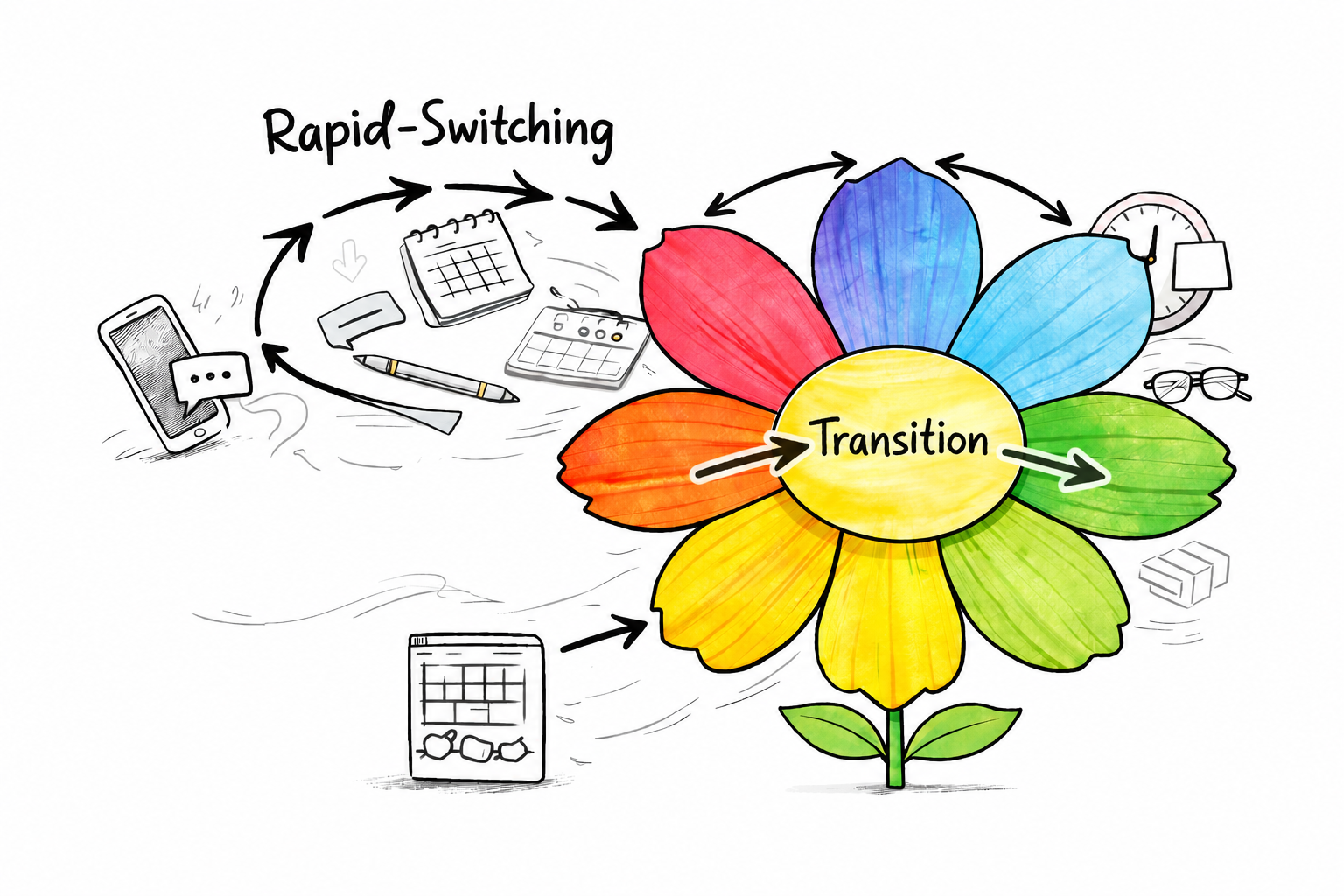
Imagine your attention as a flower.
Each petal is a theme, activity or pull on your mind: writing, parenting, cooking, work admin, a difficult conversation, a special interest, a memory loop, scrolling, planning, worrying.
People vary in how broadly or narrowly attention tends to be distributed, and the same person may also vary with context, interest, fatigue and available capacity. At one end of that variation, attention can gather deeply around one or a few active interests, while competing demands become harder to hold simultaneously. At the other end, it looks like multitasking, but in practice a lot of “multitasking” is rapid switching. Research on task switching shows that switching carries costs, and even small costs add up.
Other people, or the same person under different conditions, drop into one petal and go deep. That can feel like flow, mastery, calm and creative absorption. It can also mean the rest of the world goes quiet. Monotropism describes this as an attention tunnel, where fewer interests are active at once and those interests pull more strongly.
Now picture the flower’s centre, the pistil. This is the part most metaphors miss, and it is where the useful work happens.
To move from the blue petal to the red petal, you pass through the centre. That centre is a transition hub:
- closure of what you were doing;
- re-orientation;
- onboarding into what you are doing next.
This is not just a nice story. Task switching is not free. Task switching requires disengaging from one set of rules, demands and meanings, then activate another.
So, in this metaphor, the pistil represents something real: switching requires transition work. Attention has to disengage from one configuration of task, meaning and expectation and become organised around another. The flower is a model for thinking about that cost, not a literal account of the brain’s switching mechanism.
Why interruptions sting
Interruptions are often treated like minor events. Someone asks a quick question. A notification pops up. A partner starts talking from the other room. A colleague “just needs one thing”.
But if you are deeply on a petal, an interruption is not only a request for attention. It is a demand for an instant pistil transition.
That demand can land as irritation, panic, blankness, shutdown, or the feeling that your whole internal thread has been snapped. From the outside, this may look disproportionate. From the inside, it is not small at all.
There is evidence that people do not simply imagine this cost. In The Cost of Interrupted Work: More Speed and Stress, Gloria Mark, Daniela Gudith and Ulrich Klocke found that people may compensate for interruptions by working faster, but report more stress, higher frustration, more time pressure and more effort.
So if someone says, “I know it was small, but it made me irrationally angry,” a more accurate translation may be:
- My brain was forced to switch without completing closure and onboarding, and that felt awful.
The strengths and the trade-offs
Monotropism is not a superpower and it is not a tragedy. It is a pattern of attention allocation.
When attention pours into a petal, people may experience:
- depth of learning and skill;
- sustained engagement;
- momentum;
- satisfaction;
- interest-based connection.
The National Autistic Society describes monotropism as a strengths-based and neuroaffirming way of understanding autistic cognition. That matters, because many autistic people have spent years having their attention style misread as rudeness, obsession, inflexibility or disinterest.
Recent conceptual work on autistic flow draws striking parallels between flow states and autistic accounts of deep absorption. Heasman and colleagues propose that autistic people may have particular strengths in finding and entering flow, while entering, maintaining and especially leaving those states may also bring distinctive challenges. Flow is the state of being absorbed, motivated and fully inside an activity or experience. For many autistic people, monotropic attention may make these states more available and more intense. This is not “just a hobby” or “getting fixated”. It can be learning, regulation, pleasure, competence and a felt sense of being properly alive.
But deep petals have trade-offs.
The trade-off is not only getting into flow. It is getting out of it. The authors also draw attention to difficulties transitioning out of flow, which overlap phenomenologically with accounts of autistic inertia.: the sometimes extreme difficulty of starting, stopping or shifting state. From the outside, this may be misread as refusal or stubbornness. From the inside, it may feel more like trying to pull your whole nervous system through a keyhole.
The same focus can mean:
- switching feels like Velcro being ripped off the mind;
- background needs disappear: time, hunger, thirst, messages, appointments;
- sudden changes create overload;
- topic-jumping conversations feel exhausting;
- other people misread the slow switch as stubbornness, avoidance or not caring.
Murray, Lesser and Lawson’s original paper, Attention, monotropism and the diagnostic criteria for autism, argued that atypical strategies for allocating attention are central to autistic experience. That framing is still useful because it moves us away from moral judgement.
This is not necessarily laziness or deliberate difficulty.
It is attention doing what attention does, in a specific configuration.
Research is beginning to test monotropism more directly, and the picture is not yet simple. In a 2025 study of autistic and non-autistic adolescents, autistic participants showed greater hyperfocus on questionnaire measures, but laboratory measures of attention did not show the same group difference and the different measurement methods showed little convergence. This does not disprove lived experiences of monotropic attention; it does mean that the underlying attentional mechanisms remain an open research question.
Multitasking, switching and the shame of comparison
A lot of shame is born from a bad comparison.
People who switch more easily are often assumed to be better organised, more mature, more resilient or more socially skilled. People who switch with difficulty are assumed to be rigid, dramatic, self-absorbed or obstructive.
That comparison is sloppy.
Even in people who appear to multitask effortlessly, switching still carries a cost. The cost might be smaller. The recovery may be faster. The person may be better supported by their environment. Some activities can run concurrently, particularly when one is highly familiar or automatised. But when two tasks both require active executive control, what looks like multitasking often involves repeated switching — and switching itself carries a cost.
A kinder and more accurate framing is:
- some people have lower switching costs;
- some people have higher switching costs;
- many people’s switching costs increase under stress, fatigue, sensory load, emotional threat, illness, hormonal change, trauma activation, uncertainty or burnout.
When you stop treating switching ability as a virtue, you can stop lecturing yourself and start designing your life.
Monotropic split: when attention is pulled apart
There is a deeper version of this problem.
Sometimes the issue is not one interruption, or one transition, or one badly timed question. Sometimes a person is repeatedly expected to spread deep attention across more demands than their system can realistically hold.
Autistic writer and practitioner Tanya Adkin uses the term “monotropic split” for what may happen when a monotropic person is repeatedly required to distribute attention across more streams than feel manageable. It is a community-developed formulation rather than an established clinical construct, but it provides useful language for an experience many monotropic people recognise: being stretched across competing attentional demands until available capacity is exceeded..
This is not just “being busy”. It is an attentional overload state.
You might see it in school, where a child is expected to jump from subject to subject, room to room, social code to social code, with very little transition time. You might see it at work, where someone is meant to write, answer emails, respond to chat messages, sit in meetings, tolerate background noise and still produce careful thinking. You might see it in parenting, where cooking dinner, answering a child’s question, tracking the washing machine, managing a sensory environment and holding everyone’s emotions become one impossible braid.
The person may become increasingly distressed, irritable or cognitively overloaded; some describe reaching meltdown or shutdown.
That is not a failure of character. The response may make more sense when understood in the context of attentional load rather than character.
There is one question before technique: does this transition actually need to happen?
A more comfortable way of meeting an unnecessary demand is still compliance with an unnecessary demand. Sometimes the next task matters and the question is how to make the transition more affordable. Sometimes the useful intervention is to remove the interruption, renegotiate the expectation or decide that the next petal does not need to be entered at all.
Support the transition only after establishing that the destination is wanted or necessary.
The pistil toolkit: making switching less brutal
This is where the flower metaphor can become practical. Understanding the switching cost allows us to experiment with ways of reducing it.
You do not have to redesign your whole personality. You support the pistil.
A compact mantra helps because it is easy to remember in the moment:
One possible sequence is: close, cue, choose.
1. Close: finish, park, or bookmark
Closure does not have to mean completing the whole task. It means reducing the open loops your brain is gripping.
You can:
- finish a small sub-step: save the draft, send the one message, put the tool away;
- park intentionally: “I am stopping here on purpose, even though it is unfinished”;
- bookmark the next action in plain language, so your brain can let go without losing the thread.
This is where the dishwasher principle becomes practical: do a small reset so the next task does not jam immediately. You are not cleaning the whole kitchen. You are creating enough capacity for the next move.
2. Cue: give the next petal a runway
A heads-up is not just politeness. It is cognitive engineering, because preparation can reduce switch pain.
Useful cues may include:
- a time cue: “I am going to switch in five minutes”;
- a body cue: stand up, drink water, change posture;
- a place cue: move location if possible;
- a verbal cue: “I am moving to the next thing now”;
- a sensory cue: music, lighting change, shoes on, bag by the door.
But this is where we need to be careful.
A cue is only supportive if it is not experienced as a countdown to rupture. Jade Farrington’s Three Essential Ideas for Exploring Monotropism and Activity Switching for Monotropic Minds usefully foreground Tanya Adkin’s concept of lilipadding: transitions need bridges, not trapdoors.
A timer can help when it is chosen, trusted and part of a plan. A timer can increase distress when it means, “When this alarm goes off, you must stop whether your system is ready or not.”
So the question is not “Do timers work?”
The better question is:
Does this cue help the person move, or does it make them brace for impact?
3. Choose: onboard the next petal properly
A lot of switches fail because the next task arrives as a fog. Onboarding makes it concrete.
Try a 60-second onboarding:
- name the goal in one sentence;
- decide what “done for now” looks like;
- remove one barrier: open the file, lay out the ingredients, put shoes on;
- make the first action visible.
Less push-through. More friction-reduction.
Lilipadding: transition support without coercion
Adkin and Gray-Hammond describe “lilipadding” as relational, co-created transition support: creating intermediate steps rather than abruptly pulling somebody from one attentional state into another. It is a lived-experience-informed practice concept rather than a formally evaluated clinical intervention.
Instead of dragging someone out of flow, you create small stepping places between where they are and where they need to go. It is relational, consent-based transition support.
A lilipad might sound like:
“Lunch is soon. Would it help if I brought it to you here?”
Or:
“Do you want me to sit with you while you finish that bit?”
Or:
“Why are we requiring the switch? Would talking this with you make the next thing easier?”
The point is not to trick the person into compliance. The point is to preserve enough continuity that the nervous system can move without feeling dropped through a trapdoor.
This matters especially with children, autistic adults, ADHDers, AuDHD people, traumatised people, burnt-out people, and anyone whose attention is already carrying too much load.
Supportive transition need not be behaviour management; it can be collaborative design.
The social bit: “just a quick question” is rarely quick
In relationships, monotropism often shows up as a mismatch in switching expectations.
It can also help explain why some social connection feels effortless while other social contact feels like being dragged across gravel. When interests, pacing and communication norms line up, autistic people may experience shared flow: a form of rapport built through mutual focus, humour, depth and rhythm. When they do not line up, the problem is not automatically lack of care. It may be a clash between different attentional ecologies.
One person says, “Can you listen now?” and means, “Please connect with me.”
The other may experience the request as, “Drop what you are holding immediately,” and find that switch difficult or temporarily inaccessible.
Neither experience establishes the whole meaning of the interaction.
The need for transition time is real. So may be the other person's need for timely attention, information or connection. Monotropism can help explain the switching cost; it cannot tell us automatically whether a particular request was unreasonable, whether a response was possible, or what either person intended.
If you do not name the pistil, you get moral stories:
- “You never prioritise me.”
- “You are so demanding.”
- “You do not care.”
- “You are impossible.”
If you name the pistil, you get workable requests.
A simple script, useful at home and at work:
- “I am mid-petal. I want to come to you properly. Give me two minutes to close this, then I can be fully here.”
And from the other side:
- “I want to ask you something. Is now possible for you, or would you need some transition time first?”
That is not indulgence. It is respect for how attention actually functions.
Understanding capacity makes the conversation more accurate. It does not make impact disappear. Once both people know the pattern, they can decide what forms of signalling, transition and repair are workable for them.
The monotropism questionnaire
For a more personal starting point, you may find the Monotropism Questionnaire useful. It is a self-reflection tool, not a diagnostic test, designed to explore how your attention and interests tend to organise themselves across focus, routines, environments, deep interests, rumination, switching and social energy.
The 47-item questionnaire was developed by Valeria Garau and colleagues with an autistic-led community group and tested in 1,110 autistic and non-autistic participants. The development study reported good internal consistency and strong associations with established autism-trait measures; autism and ADHD status were both associated with higher scores. The study remains a preprint, however, and the questionnaire still needs further independent validation across populations and against measures that do not rely solely on self-report.
It is not an autism diagnostic test and there is no clinical cut-off separating “monotropic” from “polytropic” people. Higher scores suggest a more monotropic attention style, where attention gathers deeply around fewer things at a time. Lower scores suggest a more polytropic style, where attention may move more fluidly across several things.
Neither is better.
The point is not to label yourself neatly. The point is to notice your pattern more clearly, so you can stop forcing your attention to behave like someone else’s and start designing support around how it actually works.
You may also find monotropism.org useful for further reading, including resources on autism, ADHD and monotropic attention.
A final note: the flower is a map
Monotropism is a lens. It helps explain why some people thrive with depth, and why abrupt switching can feel genuinely painful. It also helps people stop interpreting irritation, shutdown or difficulty moving as a personality defect. Monotropism gives us a mechanism worth investigating. It does not settle capacity, intention, impact or responsibility in advance.
It invites a better question than:
- What is wrong with me?
Ask instead:
- What does my attention need, because switching has a cost?
Build in pistil time. Reduce pointless interruptions. Use closure. Make cues collaborative. Create lilipads, not trapdoors. Stop shaming your nervous system for being a nervous system.
Monotropism offers a way of understanding why attention may go deep and why switching can sometimes cost more than other people can see. Autistic flow theory extends that lens by asking how deep absorption may also be nourishing, creative, regulating and relational — and why transitions out of it deserve more attention.
The flower is a map, not a diagnosis and not a brain scan. Its usefulness lies in whether it helps you recognise the pattern, reduce unnecessary friction and make more informed choices about what your attention is being asked to do.
Close, cue, choose — when a switch is actually yours to make.
The information in this article is provided for general psychoeducational purposes only. It is not therapy, clinical advice, diagnosis, or a substitute for working with a qualified professional, and it should not be relied on as such. Any examples are illustrative and may not apply to your individual circumstances. If you are considering making changes to your health, wellbeing, relationships, work, or care, seek appropriate professional support tailored to you.
To the fullest extent permitted by law, we accept no responsibility or liability for any loss, harm, or outcome arising from reliance on the contents of this article. If you are in immediate danger or feel unable to keep yourself safe, contact emergency services or your local crisis support line straight away.