The Neurodivergent Authorship Framework
Therapy that helps you understand your life without taking it away from you
Published 29 August 2026 · Approx. 12-minute read
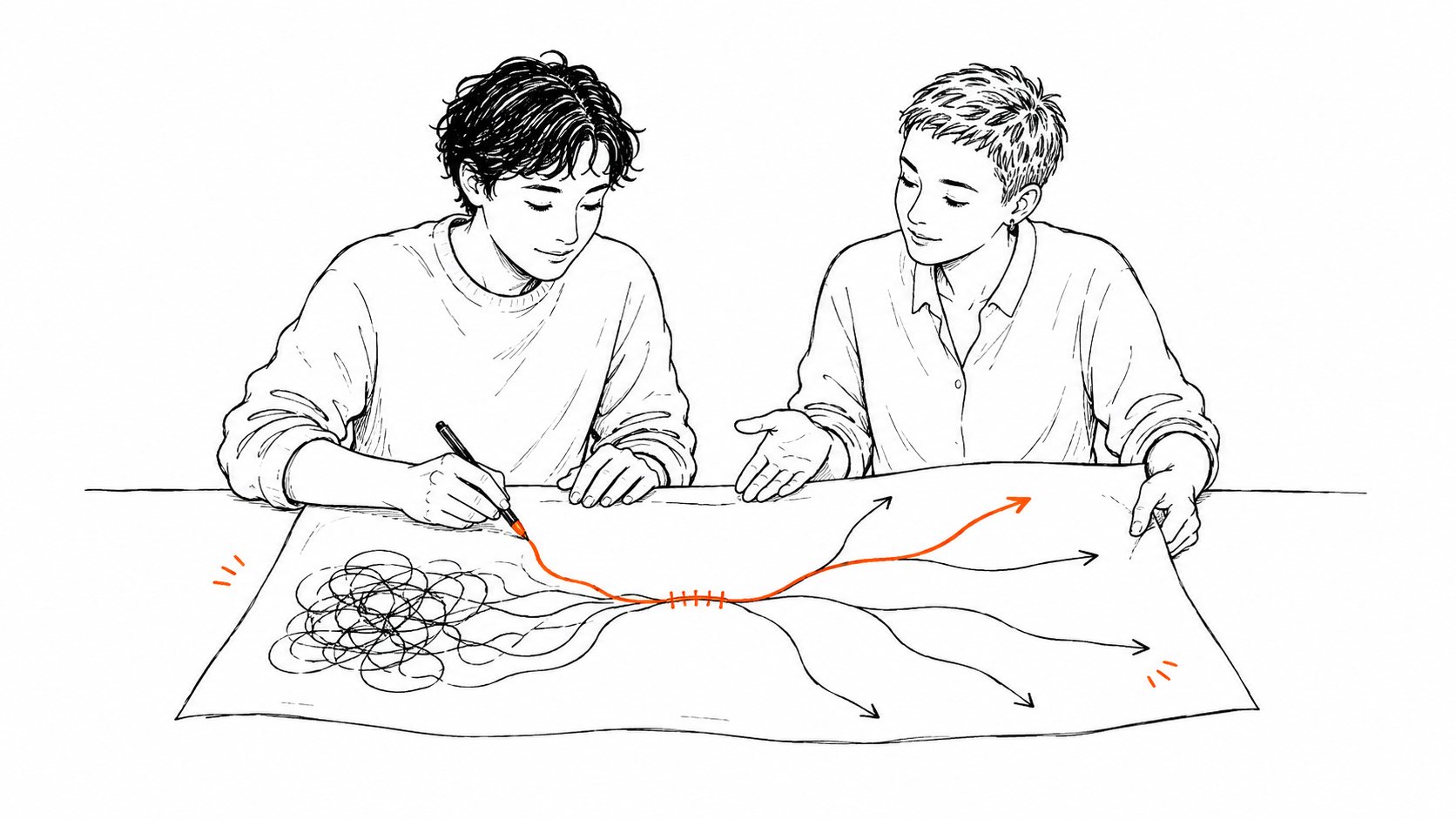
Therapy can help people recover authorship of their lives. It can also become another place where someone else tells them what their reactions mean, what they should tolerate, what they ought to want and what a more acceptable version of them would look like.
The Neurodivergent Authorship Framework is the foundation of how I think and work. It is my practice framework rather than a manualised treatment or a claim to have discovered one universal explanation for neurodivergent lives.
It begins from a simple position:
- You are not a problem for an expert to solve. You are a person whose experience deserves accurate understanding, meaningful choice and room to remain your own.
Authorship does not mean complete control, perfect self-knowledge or freedom from influence. It means participating in making sense of your experience and making increasingly informed choices that feel like yours.
The endpoint is not perfect functioning. It is something closer to:
- I belong in my life and my life belongs to me.
Why authorship matters in neurodivergent therapy
Autistic and ADHD people are often understood through expectations designed around other nervous systems. Directness may be interpreted as hostility. Withdrawal may be called punishment. Forgetfulness may be treated as proof that someone does not care. Sensory limits may be called selfishness. A need for precision may be read as argumentativeness, while a delayed response may be taken as avoidance.
Repeated correction can teach a person to distrust their own experience. Tiredness becomes laziness, pain becomes overreaction and a boundary becomes rejection. They may become highly skilled at monitoring everyone else while losing access to what they need.
This is one route into masking: not simply hiding visible traits, but organising life around an external account of who one should be. Eventually an imposed expectation can feel like a personal preference. “I want to cope better” may really mean “I want to stop inconveniencing people.”
Therapy should not replace these rules with the therapist's preferred rules. It should help us examine how the rules were formed, what they protect, what they cost and whether they still belong in your life.
The six principles
1. Mechanism before moral judgement
My work starts from the assumption that people do not act with complete information. We make decisions using the nervous system state, knowledge, capacity and understanding available at the time. Mistakes are therefore inevitable.
When something repeatedly goes wrong, I first want to understand what is happening. Is this sensory overload, executive-function difficulty, burnout, monotropic focus, fear, alexithymia, rejection sensitivity, trauma learning, communication mismatch or something else? Is the behaviour protective, automatic, deliberate — or a mixture?
This is not an attempt to make every behaviour innocent. It is an attempt to avoid using a moral explanation where a functional one is more accurate.
“They do not care” and “they did not remember” are different claims. “They are controlling” and “uncertainty has overwhelmed their available capacity” are different formulations. Either interpretation may eventually prove important, but they should not be treated as interchangeable.
- The pain is real; the verdict may be premature.
If we understand what produced the behaviour, we can identify what might be preventable, what needs accommodation, what requires a boundary and what responsibility is realistically available.
2. Capacity before expectation
Knowing what to do is not the same as being able to do it. Wanting an outcome does not guarantee the capacity required to produce it.
Capacity can be affected by sensory load, sleep, pain, transitions, working memory, task initiation, emotional arousal, masking and accumulated demands. It is variable rather than a fixed measure of character. Managing something once does not prove it is consistently available.
An expectation can be reasonable in principle and still impossible under present conditions. Repeating it more firmly does not create the missing capacity; it may add shame, threat and cognitive load.
Capacity before expectation means asking:
- What does this action require from the nervous system?
- Was that capacity available at the relevant moment?
- What conditions reduce or increase it?
- Can the demand, timing, method or support change?
It does not mean that nobody can expect anything from a neurodivergent person. It means expectations should be possible, explicit and proportionate.
- Explanation does not remove responsibility. It makes responsibility more precise.
If someone cannot reliably perform an action, responsibility may involve acknowledging the limit, seeking an alternative or not making an agreement they cannot keep. Demanding the impossible is not accountability. Neither is pretending that impact disappears because capacity was limited.
3. Understanding before change
Pressure to change can arrive before anyone has established what the behaviour means, what function it serves or whether change is desirable. I use formulation as a living, collaborative attempt to understand the pattern: the best explanation we can currently build from the available evidence, not a verdict about you.
I may say:
- “I wonder whether this could make sense in the context of…”
- “Does that resonate?”
- “What does this explanation fail to account for?”
- “Can you think of an example that contradicts it?”
Contradiction is useful. If an explanation does not fit, it needs revising. Professional knowledge offers possible models; it does not give me direct access to your inner world.
Identity also remains yours. We can consider whether autism, ADHD, trauma or another framework illuminates your experience without turning a hypothesis into your identity by professional decree.
Once we understand more, change becomes an invitation rather than a command. I may show you the most useful option I currently know; you decide whether it is doable and desirable. It can be modified, postponed, tried or declined.
All interventions are invitations.
4. Authorship before optimisation
Therapy can become organised around making someone more productive, emotionally conventional or easier to manage. This may look successful from outside while costing the client access to themselves.
- The question is not only “Does this work?” It is also:
- Who defines the desired outcome?
- What does it cost to maintain?
- Does it expand your life or make you more compliant?
- Are you acting from choice, fear, shame or exhaustion?
- Does this adaptation allow you to give from abundance, or demand that you keep giving from deficit?
There is nothing wrong with learning skills or changing behaviour. The issue is whether optimisation serves the person or the person becomes fuel for optimisation. More eye contact is not inherently progress. Remaining in a conversation while overwhelmed is not necessarily better than leaving and returning. Productivity is not success if it repeatedly ends in collapse.
Authorship may involve doing more. It may also involve stopping, declining, simplifying, changing the environment or accepting that a demand is too expensive.
My role is not to decide what your life should look like. It is to help us understand what is happening accurately enough that you have more genuine choices.
5. No neurotype has automatic authority
Each person has primary authority over their own experience. No person has unilateral authority over the meaning of a shared interaction.
This distinction is central to my work:
- Validation of impact is unconditional; acceptance of interpretation is not.
If something I do hurts you, your experience matters whether or not I intended the harm. I do not need to argue you out of what you felt. But validating your pain does not require me to accept every conclusion about my motive, character or inner world.
Someone can genuinely feel rejected without the other person having intended rejection. Someone can experience a need for space as abandonment without the withdrawal having been designed as punishment.
- You are the primary witness to your impact. I am the primary witness to my intention. Neither of us is the sole authority on the whole event.
The interaction has to be investigated between us. Behaviour, context, prior knowledge, power, patterns and consequences all contribute evidence.
This relates to the double empathy problem: misunderstanding across neurotypes can be relational rather than proof of an autistic social deficit. Mutuality does not mean equal power. Both people may contribute interpretations while only one has the authority to diagnose, exclude, punish or record their version as fact.
In couples therapy, the more socially familiar communication style does not automatically become the standard. A neurodivergent partner should not carry the entire burden of translation and repair simply because neurotypical communication is more familiar. Neurodivergence equally gives no exemption from examining impact.
Felt safety also needs care. A bodily signal is important data, not an infallible verdict. Familiarity can feel safe when a pattern is harmful; difference can feel dangerous when no harm is occurring. As I discuss in neurotransception, we neither obey the signal unquestioningly nor override it: we become curious and test the interpretation where possible.
6. Accountability through impact and afteraction
I begin with a good-person baseline. I am less interested in rapidly deciding whether someone is good or bad than in what happened, what was possible, what the impact was and what happens once more is known.
This baseline protects curiosity; it does not protect harmful behaviour from challenge.
I separate five elements:
- Observable behaviour: what was said or done.
- Inferred motive: what we believe the person intended.
- Impact: what happened to another person.
- Available capacity: what the person could realistically notice or do at the time.
- Afteraction: what they do once the impact and relevant information become available.
People need permission to make mistakes. Permanent self-surveillance before every word or action is cognitively expensive and can become another form of masking.
Permission to make mistakes is not permission to disregard harm.
Afteraction asks: Can I hear that something affected you differently from how I expected? Can I remain curious rather than defend myself or collapse into shame? Can I revise, repair or behave differently next time?
- Character is revealed less by the first mistake than by what a person does once the mistake becomes visible.
An unintended mistake and the repeated continuation of known harm are not the same. Responsibility begins when reality has had an opportunity to correct our model. Capacity still matters: someone may need processing time or regulation before responding. But “I did not intend it” cannot permanently close the conversation.
In couples work, “This hurt me” does not have to mean “You are bad”. “I did not mean it” does not mean “It did not hurt”. Understanding mechanism and validating impact can happen together.
I will interrupt dismissive, contemptuous, coercive or harmful behaviour in the session. Curiosity is not neutrality towards harm. I may explore intention, capacity and context without allowing the behaviour to continue unchecked.
The client — not the therapist — decides what they will tolerate and whether a relationship has reached its endpoint. I help make the pattern, impact, options and risks clearer; I do not decide whether a couple should reconcile or separate.
What this looks like in therapy
The first session
The first session is a working session and a mutual opportunity to assess fit. You can ask about how I work. I will ask what makes conversation more accessible: pacing, processing time, looking away, movement, directness, written language or anything else that matters.
You can tell your story in the order it comes; no neat chronology or complete explanation is required. I take notes to organise the information and begin building a coherent picture. We then agree where to go next.
Individual work
In individual therapy, we may examine nervous-system patterns, sensory and executive demands, burnout, masking, relationships, identity, trauma learning, alexithymia, rejection sensitivity or inherited rules.
The work may include clearer language, practical systems, boundaries, grief, experimentation or sustained thinking without a predetermined conclusion.
Insight is useful, but it is not the only aim. We look for whether understanding creates more room for choice. Sometimes change means doing something differently. Sometimes it means recognising that the existing demand is incompatible with your capacity or values.
Couples work
In couples therapy, I do not treat one partner as the problem or assume reconciliation is the goal. We examine each person's experience and intention, what happens between them and how power shapes whose account is believed.
We may distinguish reassurance from problem-solving, withdrawal from punishment and regulation from abandonment. We make expectations explicit and develop consent-based ways to pause, return, clarify and repair.
I support both people's authorship. That does not require artificial neutrality when harm is occurring, nor does it mean both people are equally responsible for every interaction.
Correction is welcome
You are allowed to tell me that I have misunderstood you, that an explanation does not fit, that a question is unhelpful or that you do not want to follow a suggestion. A therapist's confidence does not make an interpretation true.
Correction is not a test. Power can make disagreement difficult, especially where professional authority has previously overridden someone's experience. I try to make correction ordinary rather than exceptional.
What the framework does NOT mean
The Neurodivergent Authorship Framework does not mean:
- assuming every difficulty is caused by neurodivergence;
- assigning a neurodivergent identity without the person's ownership;
- treating bodily activation as proof that another person is dangerous;
- accepting every interpretation because the emotional impact is real;
- excusing repeated harm through diagnosis, trauma or dysregulation;
- expecting both people to carry equal responsibility where power and consequences are unequal;
- avoiding challenge, boundaries or safeguarding in the name of acceptance;
- turning every session into psychoeducation;
- promising a guaranteed transformation;
- replacing one set of compulsory rules with another.
It is also not a scientifically validated therapy model. It is a transparent synthesis of clinical reasoning, neurodivergent-affirming and relational practice, psychoeducation, double empathy and an ethical commitment to agency. Its concepts have different levels of empirical support; where evidence is uncertain, I aim to say so.
My practice is guided by the BACP Ethical Framework. Ethics are also enacted through consent, clarity, attention to power, accountability and the client's participation in decisions about their life.
What progress may look like
Progress is not measured by how closely you resemble a neurotypical ideal or how readily you comply with therapy.
It may look like:
- recognising the mechanism before turning against yourself;
- distinguishing a limit from a personal failure;
- noticing when an expectation is impossible, unclear or too expensive;
- identifying what belongs to you and what was absorbed from repeated correction;
- setting a boundary without converting the other person into a villain;
- hearing impact without surrendering authorship of your intention or character;
- making repair without collapsing into shame;
- leaving an overwhelming interaction and having a clear route back;
- choosing support or change because it fits—not because you have been overruled;
- moving from survival work towards maintenance, fine-tuning and a life with less unnecessary friction.
Therapy does not have to end when a crisis passes. Some people value longer-term maintenance: noticing new patterns and expanding awareness without waiting for life to become unmanageable again.
I do not measure successful therapy by obedience. I look for increasing agency: more accurate understanding, more usable choices, clearer limits, greater capacity to protect the nervous system, and accountability that does not require self-erasure.
The centre of the framework
The Neurodivergent Authorship Framework can be reduced to a few commitments:
- Mechanism before moral judgement.
Capacity before expectation.
Understanding before change.
Authorship before optimisation.
Impact without mind-reading.
Accountability through afteraction.
The aim is not to make you easier to manage. It is to help you understand your life accurately enough to live it with more choice, less unnecessary shame and responsibility that is genuinely yours.
- I belong in my life and my life belongs to me.