De-apperception: does this belong to now? Does this belong to me?
Published 3 September 2026 · Approx. 8-minute read
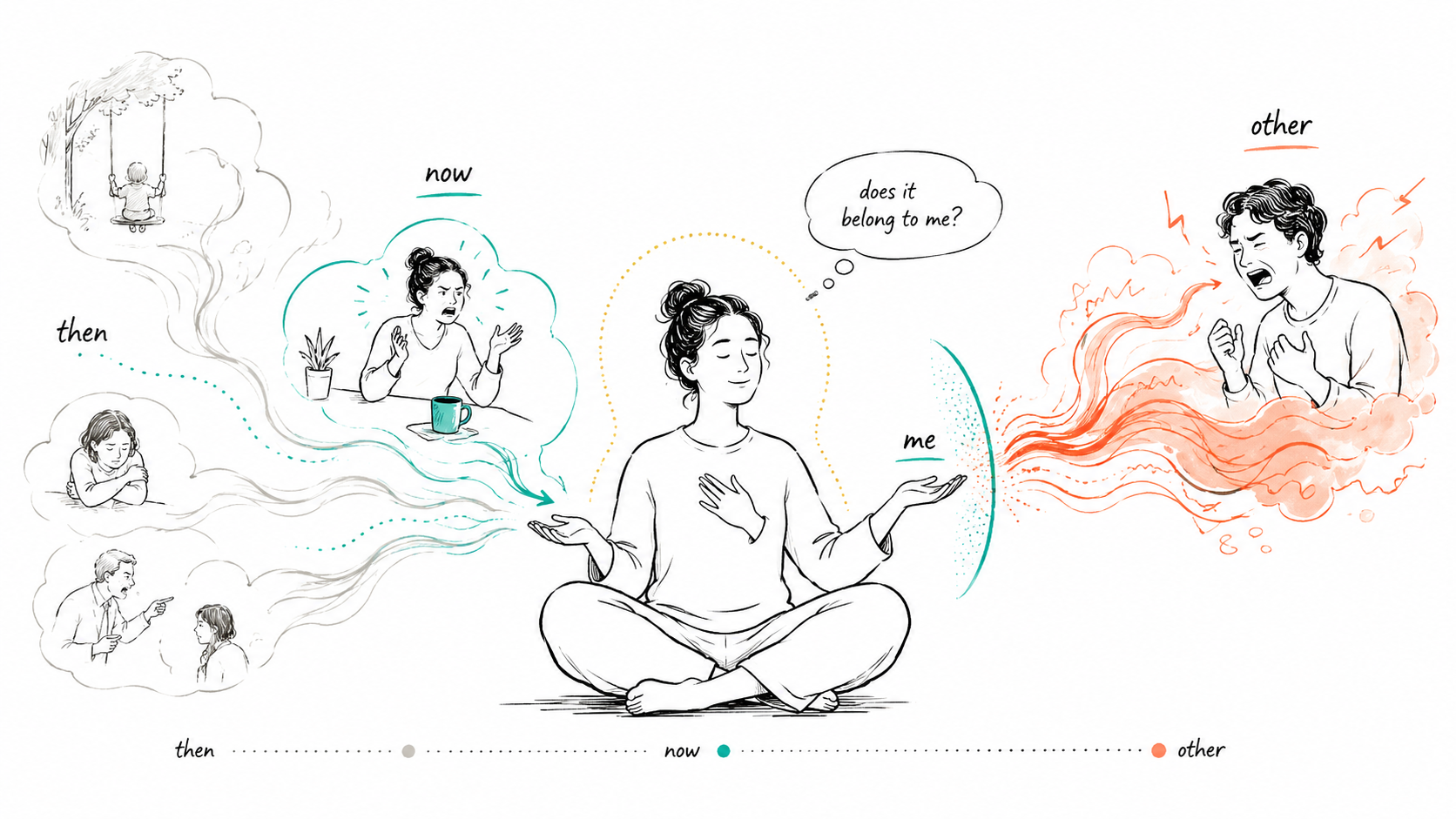
An emotion can be completely real while carrying information from more than one place.
I may be frightened by what is happening now — and by what happened ten years ago.
I may feel another person’s distress in my own body without that distress primarily being mine.
I may be furious about today’s interaction while the scale of the fury has been enlarged by twenty previous interactions my nervous system has not forgotten.
We tend to experience emotion as a single thing:
I feel this, therefore this is what is happening.
But emotion does not arrive with metadata. It does not tell us how much belongs to the current event, previous experience, sensory overload or another person’s distress.
Everything arrives together.
I use the term de-apperception for a deliberate attempt to loosen that togetherness for a moment. Not to dismiss emotion, but to examine its provenance.
Two questions are central:
Does it belong to now?
Does it belong to me?
The purpose is not to make emotion smaller. It is to locate it more accurately.
What is apperception?
Apperception has a long history in philosophy and psychology. William James described incoming experience as being understood through existing memories, habits, knowledge and previous experience. What we perceive now is therefore never entirely independent of what we have perceived before. (Psych Classics)
Contemporary predictive-processing theories describe something compatible in different language. Previous learning contributes to predictions about what incoming sensations mean, while current sensory information interacts with those predictions. Together they help shape perception, bodily experience and emotion. (PubMed Central)
We do not encounter the present empty-handed. Our nervous systems bring history with them.
Usually this is useful. But previous experience can sometimes become so influential that it becomes difficult to distinguish:
- what is happening from what this resembles.
That is where de-apperception becomes useful.
I use de-apperception to mean:
- A deliberate, temporary differentiation of present experience from the previous experiences, predictions and interpersonal emotional states contributing to it, before deciding what the emotion means and what response is needed.
The word temporary matters.
The goal is not perception untouched by history. That is probably impossible. Nor is the past irrelevant.
De-apperception is not deletion.
It is briefly separating instruments in music that normally reaches us as one sound:
- What is playing here?
Does it belong to now?
This is temporal discrimination: past from present.
Imagine that someone does not reply to an important message.
An immediate surge appears:
- Something is wrong.
- They are withdrawing.
- I have done something.
- They are going to leave.
Your body may already be participating through nausea, agitation, heat, tightness or repetitive checking.
All of that is happening now.
But does all of it belong to now?
Perhaps previous silence meant punishment. Perhaps important relationships disappeared without explanation. Perhaps this partner has previously withdrawn affection after conflict. Perhaps repeated misunderstanding has taught your nervous system that ambiguity requires urgent investigation.
Or perhaps this person really is behaving in a way that threatens the relationship.
These possibilities cannot responsibly be collapsed into:
- “This is your trauma.”
Nor should they automatically become:
- “My feeling proves my interpretation.”
De-apperception asks:
- What is the present event contributing, and what has arrived with it?
Trauma therapy already contains a close relative. Cognitive Therapy for PTSD uses “Then versus Now” discrimination to distinguish present cues from earlier traumatic situations they activate. (PubMed Central)
De-apperception extends that enquiry beyond PTSD.
The question is not necessarily whether the present is safe. Sometimes it is not.
The question is whether the emotional meaning assigned to the present belongs entirely to this event.
Past does not mean irrelevant
Suppose a partner has repeatedly broken trust and is late home today.
Some of today’s anxiety may consist of stored consequences of those earlier breaches. The previous events are not happening now, but they remain relevant evidence about this relationship.
De-apperception must therefore never become:
- “That belongs to the past, so stop responding to it.”
That confuses temporal location with relevance.
Instead ask:
- Is my nervous system responding to an old situation that merely resembles this one?
or:
- Is it responding to accumulated evidence about this actual person or relationship?
Sometimes history distorts the present. Sometimes history provides useful data about the present. Often both are happening.
A present feeling can also be historically amplified rather than historically caused.
If a partner suddenly stops communicating during disagreement, someone whose childhood experience associated silence with punishment may experience terror.
The terror may be historically amplified.
But the partner is also refusing to communicate.
After differentiation, the experience might become:
- “I am not in the danger my body initially predicted. But I am angry that you have stopped engaging with me.”
The emotion has not been argued away.
It has gained resolution.
Does it belong to me?
The second form of de-apperception concerns self and other.
Human nervous systems affect one another. We respond to tone, facial expression, posture, movement, silence, agitation and distress.
Research on empathy distinguishes between sharing aspects of another person’s affective state and maintaining awareness of the distinction between self and other. Emotional contagion can involve affective state-matching with less differentiation between the two. (PubMed Central)
So when I ask:
- Does it belong to me?
I do not mean that somebody else’s emotion has somehow entered my body.
If anxiety is happening in my body, the anxiety is mine as an experience.
The question is:
- Is this state primarily information about my own needs and circumstances, or has my nervous system become organised around the emotional state of the person I am with?
Containment without absorption
Imagine one partner becomes intensely distressed.
The other becomes distressed because the first is distressed.
The first detects that distress and becomes more frightened.
The second becomes increasingly desperate to make the first person stop feeling.
Very quickly:
- your distress → my distress → your response to my distress → more of my distress → more of yours
Two nervous systems have become an amplification circuit.
What looks like lack of empathy may sometimes involve too little differentiation within empathy.
Someone might notice:
- “There is a lot of panic here. My body has started panicking too. But I wasn’t frightened before you became frightened.”
That recognition does not require withdrawal.
It may make remaining present possible.
If I can recognise:
- this feeling is happening in me partly because you are suffering
then I do not need you to stop suffering in order for me to become regulated.
I can contain without absorbing.
Why this may matter in neurodivergent relationships
De-apperception is not specifically a neurodivergent intervention, but it may be particularly useful in neurodivergent therapy.
Some neurodivergent people experience high sensory or interpersonal intensity or identify bodily and emotional states more slowly or differently. A state may therefore be unmistakably present before its source becomes clear:
- Something is happening very strongly.
before:
- I know what it is, where it came from or what it requires.
Sensory overload, fatigue, burnout and conflict may make differentiation harder still.
There may also be considerable accumulated interpersonal experience. Repeated misunderstanding can make puzzlement feel dangerous. Repeated rejection can make small uncertainty recruit much larger consequences. Masking may involve close monitoring of other people’s tone, expression and emotional shifts.
And double-empathy problems mean another person’s interpretation of our state may itself be wrong.
De-apperception therefore offers curiosity before conclusion.
Not:
- “You are too sensitive.”
Not:
- “Your nervous system is wrong.”
Not:
- “If you feel rejected, you were rejected.”
But:
- “Something important is happening. Let’s find out what information is in it.”
History as background, not template
Eugene Gendlin described a related distinction. Previous experience can operate as a fluid background helping us understand new experience, or an old experience can become effectively “frozen”, entering the present as a whole and making the new situation conform to it. (The International Focusing Institute)
That captures something important.
Healthy use of history is not the absence of history.
It is allowing previous experience to inform a new situation without forcing the new situation to become the old one.
De-apperception cannot provide emotional accountancy. We cannot meaningfully calculate:
42% childhood, 28% previous relationship, 30% Tuesday afternoon.
We only need enough differentiation to recognise that several processes may be operating at once.
A de-apperceptive enquiry
In practice, I use three questions.
1. Does it belong to now?
Ask:
- What happened immediately before this feeling?
- What does this situation resemble?
- Have I experienced this particular bodily or emotional state elsewhere?
- Is something happening now, or is my nervous system predicting what might happen next?
- What evidence from the history of this actual relationship remains relevant?
Then:
- What part of this feeling still fits what is happening now?
2. Does it belong to me?
Ask:
- What was I feeling before this interaction?
- Did my state change sharply when the other person’s state changed?
- If they were calm, what might I be feeling?
- Am I responding to something I need, or urgently trying to make their emotion stop?
- Can I recognise their distress without becoming equally distressed?
The aim is not:
- “That’s yours. Deal with it.”
It is:
- I can recognise your experience as yours while remaining aware of my response as mine.
3. What still needs responding to?
The first two questions differentiate. The third reintegrates.
Perhaps:
- “Most of the terror belongs to then. But the disrespect belongs to now.”
Perhaps:
- “The panic escalated when she panicked. I can be with her without joining the escalation.”
Perhaps:
- “I thought this was rejection sensitivity. Actually, he has repeatedly excluded me from decisions that affect me.”
Or:
- “Nothing dangerous is happening now. My body recognised a shape that used to mean danger.”
Then ask:
- Given what I know now, what response serves me?
Not emotional scepticism
De-apperception does not ask clients to distrust emotion.
Emotion is information.
But information requires interpretation.
A smoke alarm tells us it has detected something. It does not tell us whether the house is burning, the toast is burning or the sensor has mistaken one form of smoke for another.
We do not solve that problem by smashing the alarm.
We investigate.
An emotion can therefore be valid without every interpretation attached to it being accurate.
And recognising historical material does not make a present relational problem disappear.
Not necessarily regulation
De-apperception is also not fundamentally a calming technique.
Sometimes differentiation reduces emotional intensity.
Sometimes it does the opposite.
Someone may ask:
- “Does it belong to now?”
and discover:
- “Yes. Almost entirely.”
They may become more angry because the situation has become clearer.
Or:
- “Does it belong to me?”
may produce:
- “Yes. I thought I was absorbing her anxiety, but actually I am frightened because I do not feel safe here.”
That is successful de-apperception.
The measure is not:
- Did I calm down?
It is:
- Do I understand more accurately what I am responding to?
Regulation may follow. Boundary-setting may follow. Compassion, leaving or doing nothing may follow.
The information comes before the prescription.
A possible mechanism
De-apperception can be understood as affective source discrimination.
Ordinarily:
- current input + previous learning + bodily state + interpersonal information → one experienced emotional reality
De-apperception briefly opens that equation:
- What is current?
- What is predicted from before?
- What is happening in my body?
- What is happening between us?
- What has been evoked by the other person’s state?
Those strands can then be brought back together into a more differentiated appraisal.
From a predictive-processing perspective, one possible interpretation is that this temporarily reduces the unquestioned authority of an existing prediction and gives greater weight to present evidence. This is a theoretical interpretation rather than an established neuroscientific mechanism specifically demonstrated for de-apperception.
The simpler clinical proposition is enough:
- a nervous system cannot learn that now is different from then if then and now are never distinguished.
From emotional certainty to emotional resolution
“I feel it, therefore it is true” gives emotion too much responsibility.
“Feelings aren’t facts” gives emotion too little respect.
Feelings arise within nervous systems trying to make sense of bodies, environments, histories and other people.
They matter enormously.
But they arrive assembled.
De-apperception is an invitation to look briefly at that assembly:
- Does it belong to now?
- Does it belong to me?
- What still needs my attention?
Sometimes what remains is old fear needing care.
Sometimes it is another person’s distress that I can accompany without drowning alongside them.
Sometimes it is sensory overload masquerading as a relationship crisis.
Sometimes accumulated experience is warning me that something genuinely is happening again.
And sometimes the answer is simply:
- Yes. This belongs to now.
- Yes. This belongs to me.
- And I need to respond to it.
That, too, is successful de-apperception.
The purpose is not less emotion.
It is better resolution: enough separation between the strands of experience to know what we are actually responding to, without losing the information carried by them.
The information in this article is provided for general psychoeducational purposes only. It is not therapy, clinical advice, diagnosis, or a substitute for working with a qualified professional, and it should not be relied on as such. Any examples are illustrative and may not apply to your individual circumstances. If you are considering making changes to your health, wellbeing, relationships, work, or care, seek appropriate professional support tailored to you.
To the fullest extent permitted by law, we accept no responsibility or liability for any loss, harm, or outcome arising from reliance on the contents of this article. If you are in immediate danger or feel unable to keep yourself safe, contact emergency services or your local crisis support line straight away.