How to stay in a relationship when love is present but nervous systems clash
Published 10 March 2026 · Approx. 12-minute read
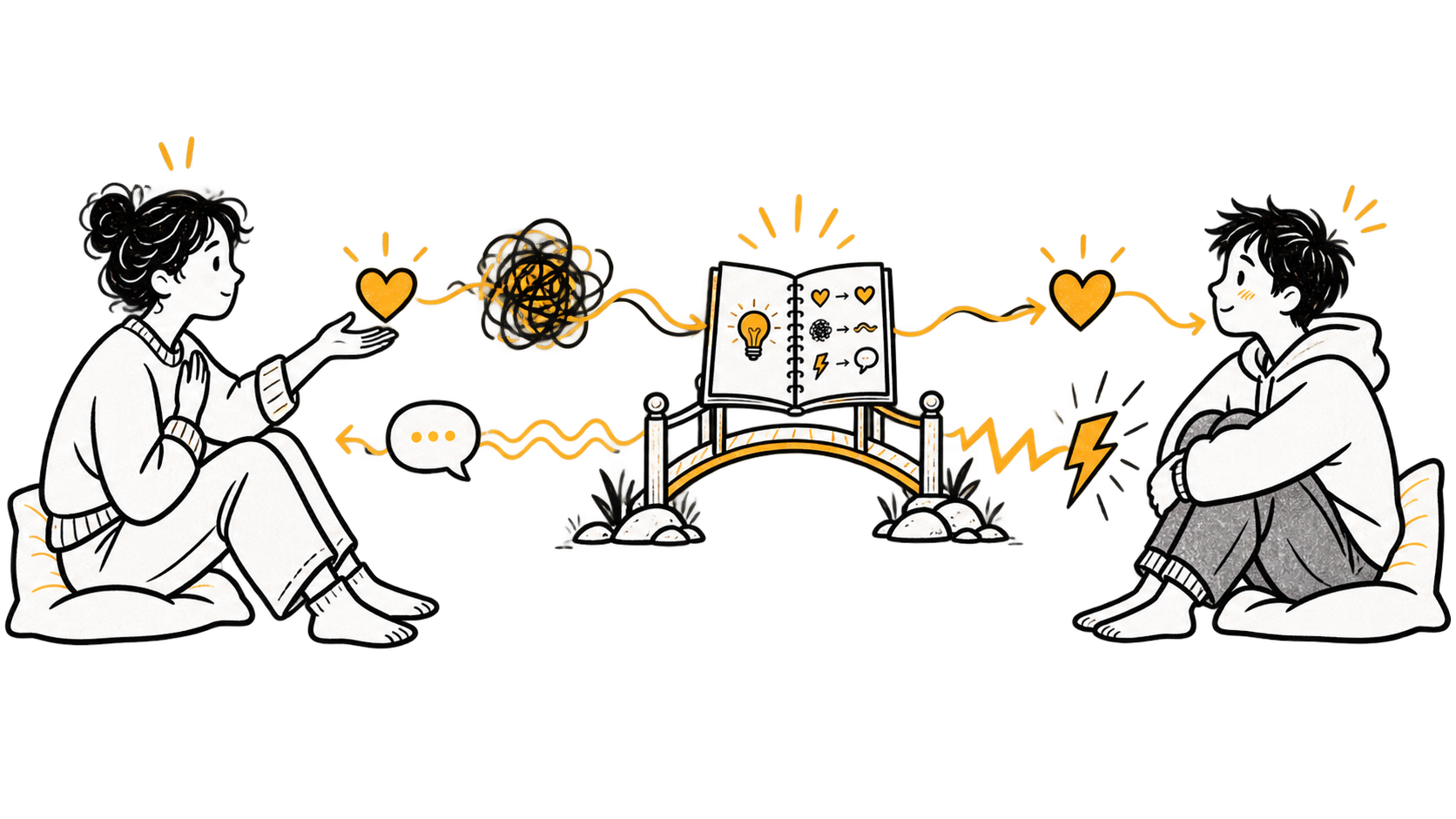
Love is not always the bit that breaks first.
Quite often, the love is still there. The care is still there. The commitment may still be there. What keeps failing is the translation.
One person needs time to process and becomes less able to speak when pushed. The other needs a response quickly because silence creates uncertainty. One experiences planning as care; the other experiences planning as pressure. One asks for reassurance to restore connection; the other begins to experience repeated reassurance as interrogation or emotional homework they can never quite complete.
From the outside, these couples are often described as being “bad at communication”.
That can be too flimsy an explanation. It describes the visible problem without telling us why it keeps happening.
Sometimes the difficulty is better understood as a mismatch between different patterns of processing, attention, communication and regulation. Research increasingly supports this relational rather than purely deficit-based view of autistic communication. Autistic adults can establish strong rapport with other autistic people, while mixed-neurotype interactions may involve more difficulty or lower rapport. (Sage Journals) Experimental work comparing matched- and mixed-neurotype pairs also suggests that communication success depends partly on the combination of people involved rather than simply on whether one person is autistic. (ASHA Publications)
This does not mean every disagreement is caused by neurotype.
It means that before deciding somebody is selfish, controlling, uncaring, unreasonable or deliberately difficult, it may be useful to ask:
What is actually happening between these two people?
The examples below are fictional composites drawn from recurring clinical patterns rather than descriptions of identifiable clients.
Good intentions are not self-translating
One of the cruellest things about relationship conflict is that a caring action can arrive looking like its opposite.
One partner thinks:
- I am asking questions because I care.
The other experiences:
- I am being interrogated.
One thinks:
- I am giving you space.
The other experiences:
- You have abandoned me.
One thinks:
- I am organising things so you don't have to worry.
The other experiences:
- You are controlling everything.
One thinks:
- I am being precise.
The other hears:
- You are criticising me.
Good intentions do not guarantee that an interaction will feel safe or regulating to the other person. Love does not automatically translate across different processing, communication and regulation patterns.
But neither does impact automatically reveal intention.
That distinction becomes important.
If my partner's silence frightened me, my fear is real. It does not automatically establish that my partner intended to punish or abandon me.
If my direct language hurt my partner, saying “I didn't mean it that way” does not make their hurt disappear.
A relationship turns into a courtroom surprisingly quickly when people confuse these levels of information.
The prosecutors are often very confident:
- If you loved me, you would have known.
- If you trusted me, you wouldn't need reassurance.
- If you cared, you would have remembered.
- If you respected me, you wouldn't need time before answering.
The evidence is usually rather less tidy.
Move from behaviour to enquiry before character
Many couples stay stuck because they move very quickly from behaviour to character.
You forgot → you don't care.
You need time → you are avoiding me.
You keep asking → you don't trust me.
You are direct → you are cruel.
You became overwhelmed → you are making everything about you.
Sometimes those interpretations will prove accurate. People can neglect, avoid, control and behave cruelly.
But the behaviour alone does not establish the verdict.
A more useful sequence is:
What happened?
What did each person experience?
What did each person think it meant?
What was intended?
What capacity was actually available?
What pattern keeps producing the same collision?
This is not an exercise in letting everyone off the hook.
It is an attempt to find the right hook.
Open and honest — at whose speed?
“Just communicate openly and honestly” is popular relationship advice.
Open and honest at whose speed?
Imagine one person can identify a concern, find words for it and begin discussing it in thirty seconds. Their partner may need twenty minutes, several hours or overnight before they can organise an answer.
Without an explicit agreement, urgency easily becomes the default tempo.
The person who needs more processing time may become increasingly overloaded. The person waiting for an answer may be left with prolonged uncertainty.
Neither person's preferred pace should automatically become the relationship's standard.
Useful structures may include:
- one question at a time rather than five;
- agreeing when a conversation will resume rather than disappearing indefinitely;
- allowing written communication;
- saying what kind of answer is actually needed;
- distinguishing “I cannot answer yet” from “I refuse to answer”;
- allowing the slower processor to complete a thought without interruption;
- allowing the waiting partner some predictable information about when contact will resume.
These are not indulgences.
They are ramps.
And when there is no ramp, one person often ends up trying to drag the other up the stairs.
Sensory and cognitive load enter the relationship too
Sometimes a partner arrives home apparently distant.
The other person sees:
- You don't want to be near me.
But the internal situation may be:
- fluorescent office lights + commute + conversation + hunger + masking + clothing discomfort + unfinished work + transition into home.
They may not be rejecting closeness at all. They may simply have very little capacity left for additional input.
That distinction matters because the solution to:
- You don't love me
is very different from the solution to:
- I need twenty minutes with no language before I can access social contact again.
Equally, a partner cannot be expected to infer this perfectly.
“I need some quiet first; I will come and find you afterwards” may be much easier to live with than unexplained disappearance.
A useful relationship often learns to distinguish:
not available yet
from
not available at all.
Planning, memory and the domestic courtroom
Appointments, shopping lists, birthdays, bills, cleaning, repairs and school arrangements look like administrative topics.
They are practical problems — but they can also become attachment topics wearing office clothes.
When one partner repeatedly forgets something, the other may begin compensating:
remembering, prompting, checking, organising and monitoring.
Then resentment grows in stereo.
One person thinks:
- I have to carry everything.
The other thinks:
- Everything I do is monitored because I'm incompetent.
Recent research involving 355 adults with ADHD describes precisely this kind of strain, including rejection sensitivity, instability and a recurring shift from partner-to-partner relating towards a partner/caregiver dynamic. Greater self-understanding was also described as important in changing relationship patterns. (PMC)
The useful question is not:
- Which partner is the bad adult?
It is:
- What genuinely needs doing, what prevents it happening reliably, and how can responsibility be organised without one person disappearing under the load?
Intention alone does not guarantee execution.
Externalising memory, changing reminders, automating tasks, reducing initiation steps or redistributing responsibilities can alter what is actually available.
But neurological explanation is not an infinite exemption.
If both people now know that an important responsibility repeatedly fails under the current system, what happens after that knowledge matters.
Reassurance is relational and physiological
Reassurance is another frequent battleground.
One person becomes frightened:
- “Are we OK?”
Their partner answers:
- “Yes.”
Ten minutes later:
- “Are you sure?”
The person asking may be trying to restore connection, settle uncertainty and regulate a very real alarm.
The partner answering may initially be happy to help. After the fifth repetition, however, they may feel that their answer has no value.
It is tempting to divide this neatly into:
reassurance = relational
and
regulation = physiological.
Human beings are not that tidy.
Reassurance can communicate information, repair connection and help one nervous system settle in the presence of another. In that sense, reassurance itself can be co-regulation.
The difficulty arises when repeated reassurance becomes the only route available for managing uncertainty.
If the alarm returns immediately after every answer, asking the partner to produce an even more convincing version of the same sentence may eventually exhaust both people.
The question becomes:
What can reassurance realistically provide, and what else would help this nervous system tolerate the remaining uncertainty?
This allows reassurance without turning one partner into an indefinitely renewable anxiety-regulation device.
Impact, interpretation and intention are different information
This distinction has become one of the most useful things I know in couples work.
Suppose one partner withdraws during an argument.
The other says:
- “You abandoned me.”
There may be several layers here:
Fact: the partner stopped engaging and left the room.
Impact: the other person felt frightened, alone or rejected.
Interpretation: you left because you wanted to punish me.
Intention: perhaps the person was trying to stop themselves becoming overwhelmed; perhaps they were punishing; perhaps both motives were present; perhaps they did not fully know.
The impact does not need to be argued away while intention is investigated.
- Your experience is real. Our explanation of why it happened can remain open long enough to examine it.
The reverse matters too.
- I didn't intend to hurt you
is information about intention.
It is not a veto over impact.
Couples often become much less trapped when they stop trying to make one of these levels erase all the others.
Understanding changes responsibility; it does not remove it
There is an important point after the first explanation.
Before somebody understands a pattern, they may genuinely lack important information.
Perhaps they did not know that disappearing without saying when they would return produces severe uncertainty.
Perhaps they thought repeated reminders were supportive rather than experienced as surveillance.
Perhaps nobody had explained that rapid multi-question conversations reliably remove their partner's ability to respond.
Once that information becomes available, the useful question shifts.
What happens now that we know?
Does the couple develop a return-time agreement?
Does somebody attempt to reduce a behaviour that repeatedly causes harm?
Does the other partner modify a demand that repeatedly exceeds capacity?
Is repair attempted?
Is the same explanation offered indefinitely while nothing changes?
Understanding mechanism can reduce unnecessary shame.
It should also make afteraction more possible: what each person does with knowledge once they have it.
A behaviour that was genuinely invisible yesterday does not remain equally invisible after it has been described clearly fifty times.
Not every clash is a translation problem
This safeguard matters.
A nervous-system formulation should not manufacture symmetry where there is none.
Threats, intimidation, coercive control, physical or sexual violence, deliberate humiliation, financial control or repeatedly overriding a clearly stated boundary do not become a mutual “communication issue” merely because both people are distressed.
Nor should diagnosis become a trump card:
- I am autistic, therefore you must tolerate this.
- I have ADHD, therefore remembering this can never be expected.
- I am traumatised, therefore you must reassure me until I feel safe.
- I am anxious, therefore you cannot leave.
Useful questions include:
Who can safely say no?
Whose distress becomes an instruction for the other person?
What happens when a boundary is stated?
Can either person leave the interaction without retaliation?
What changes once harm is understood?
Explanation can make accountability more accurate.
It should not make power disappear.
Build the manual instead of winning the case
One of the most useful shifts I see is when couples stop trying to win the case and start building the manual.
Not a universal relationship manual.
A manual for these two people.
It might include:
- When I am overloaded, language becomes harder before I realise it is happening.
- If you need an answer today, tell me that explicitly.
- If I ask for reassurance twice, I probably need reassurance. If I am still asking after that, something else may need attention.
- I need plans in advance to enjoy spontaneity.
- I need some spontaneity or life begins to feel controlled.
- If you leave an argument, I need to know whether you are returning.
- If I say I cannot talk yet, pursuing me usually makes the delay longer.
- If you need me to remember something important, spoken information alone is unreliable.
Rigid spontaneity is a ridiculous phrase until it happens to be exactly what a particular couple needs.
There is some empirical support for this emphasis on individualised relationship design. Recent qualitative work with autistic adults describes relationships shaped by explicit communication, mutual understanding and rejection of prescriptive norms in favour of arrangements that actually work for the people involved. (PMC)
The objective is not to discover how a normal couple should work.
It is to discover what is workable for this one.
Translation is reciprocal
Neurodivergent-affirming couples work can itself become distorted if affirmation means that the neurodivergent person's experience automatically outranks the other's.
That simply installs a different default authority.
If an autistic partner needs processing time, that need matters.
If their partner needs enough information to know whether an important issue will ever be discussed, that also matters.
If an ADHD partner repeatedly forgets tasks because prospective memory and initiation are unreliable, that mechanism matters.
If their partner has carried years of additional labour as a result, that impact also matters.
No neurotype should automatically hold authority over the meaning of shared reality.
The task is not:
- Who has the correct nervous system?
It is:
- What arrangement can these particular people genuinely live with?
Translation is not an obligation to stay
There is an assumption hidden inside a lot of couples advice:
If people could only understand each other properly, the relationship would work.
Sometimes it does.
Understanding can transform what once looked like indifference into processing difficulty, what looked like hostility into directness, or what looked like control into an attempt to create predictability.
But sometimes better translation reveals something less comfortable.
A partner may finally understand exactly why the other needs what they need — and realise that living with that requirement costs too much.
A person may understand that their partner cannot reliably provide the frequency of contact they want.
Neither person needs to be defective for the mismatch to remain substantial.
Research on autistic romantic relationships similarly cautions against trying to force relationships into predetermined norms; individual preferences, explicit negotiation and mutual understanding matter. (PMC)
So:
- A processing or nervous-system mismatch does not automatically mean incompatibility. Understanding it does not automatically mean compatibility either.
Therapy does not need to decide when the cost is “enough”.
Better information gives each person more authorship over that decision.
What actually helps?
There is no universal neurodivergent relationship protocol.
But some questions are consistently useful.
Instead of:
- Who started it?
try:
- Where did the interaction stop translating?
Instead of:
- Who is more emotional?
try:
- What happened to each person's capacity as the interaction escalated?
Instead of:
- Why can't you just communicate normally?
try:
- What format makes this conversation more accessible to both people?
Instead of:
- Who is right?
try separating:
- fact, impact, interpretation, intention and available capacity.
Instead of:
- How do we stop this happening?
also ask:
- What do we want to happen instead, and is that goal genuinely acceptable to both of us?
And perhaps most importantly:
- What happens now that we understand the pattern?
Knowing why something happens is useful.
What people do with that information is where the relationship begins to change — or where its limits become clearer.
Practising translation
That is the work: not performing compatibility, but practising translation.
Some relationships are repeatedly injured not because love is absent, but because the same event keeps acquiring different meanings in two people's minds and nervous systems.
Better translation can reduce unnecessary injury.
It can make room for processing time, clearer boundaries, practical systems, explicit reassurance, reduced sensory demand and more accurate repair.
It can also reveal where accommodation has quietly become self-erasure, where one person's distress controls the other, or where two legitimate needs remain too costly to reconcile.
The point is not to preserve a relationship at any price.
Nor is it to identify the guilty neurotype.
It is to stop fighting the wrong enemy long enough to understand what is actually happening.
Then each person can ask a different question:
- Now that I can see the pattern more clearly, what do I want to do with what I know?
That is where translation becomes agency.
The information in this article is provided for general psychoeducational purposes only. It is not therapy, clinical advice, diagnosis, or a substitute for working with a qualified professional, and it should not be relied on as such. Any examples are illustrative and may not apply to your individual circumstances. If you are considering making changes to your health, wellbeing, relationships, work, or care, seek appropriate professional support tailored to you.
To the fullest extent permitted by law, we accept no responsibility or liability for any loss, harm, or outcome arising from reliance on the contents of this article. If you are in immediate danger or feel unable to keep yourself safe, contact emergency services or your local crisis support line straight away.