Meltdowns and shutdowns: understanding overstimulation and taking back agency
Published 13 April 2026
12-minute read
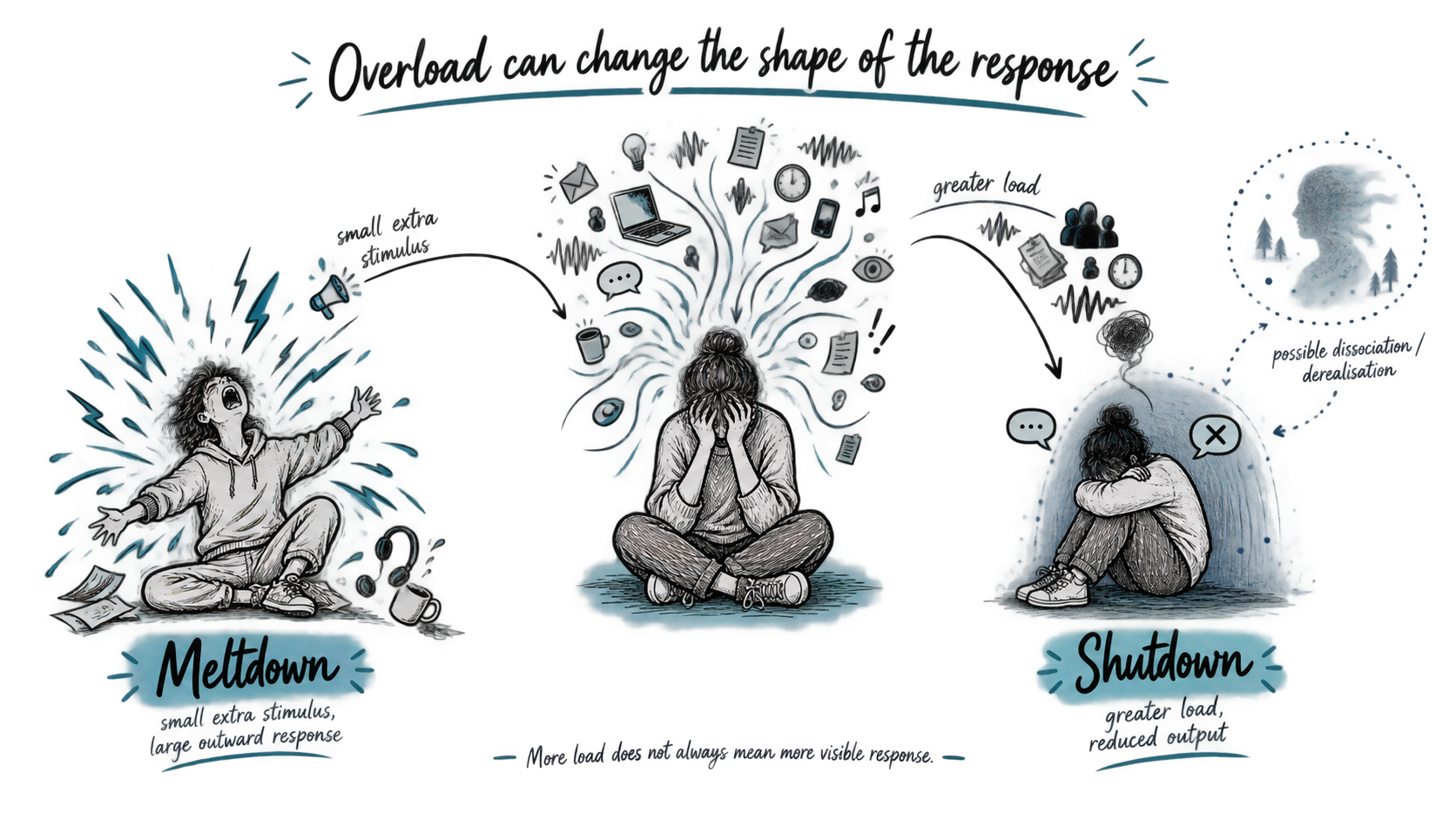
Many neurodivergent people know the feeling of “too much” accumulating. Sometimes it becomes obvious and outward: crying, shouting, pacing, agitation, loss of access to usual behavioural control. At other times, the opposite happens: speech becomes difficult or unavailable, movement reduces, thinking slows, and the person retreats from interaction.
The terms meltdown and shutdown are commonly used for these different experiences of overload.
Neither term describes a single neurological mechanism, and neither should be used to explain every intense or withdrawn state in an autistic, ADHD or otherwise neurodivergent person. But first-person research increasingly supports what neurodivergent people have described for years: these states can involve profound changes in access to speech, movement, decision-making, emotion and behavioural control.
In a qualitative study of 32 autistic adults, Lewis and Stevens found that meltdowns were associated with sensory, cognitive, social and emotional overwhelm, intense affect, difficulty thinking and reduced control over behaviour. Lewis & Stevens (2023), The lived experience of meltdowns for autistic adults
A newer participatory study drawing on accounts from 86 autistic adults found that shutdown was described through metaphors such as being frozen, a computer crash, going inside oneself, being unable to keep up and survival mode. Physical and/or vocal immobilisation was common. Paris et al. (2026), autistic shutdowns
The important question is therefore not simply:
Why did the person react so much — or so little?
It may be:
What happened to the relationship between load, available capacity and response?
Overload is more than one loud noise
Overload can arise from sensory input, but sensory demand is only one part of the picture. Available capacity can also be consumed by:
- rapid conversation or multiple instructions;
- interruption and task-switching;
- decision-making;
- social monitoring and masking;
- uncertainty or perceived rejection;
- conflict;
- pain or illness;
- hunger, hormonal change or lack of sleep;
- accumulated demands without sufficient recovery.
The relevant load is therefore not simply what happened immediately before the meltdown or shutdown.
A dropped spoon may be the final event in a day containing fluorescent lighting, uncomfortable clothing, hunger, six unfinished tasks, social monitoring, three unexpected changes and an argument.
Looking only at the spoon produces a misleading question:
- “How could something so small cause such a big reaction?”
It may not have.
It may simply have arrived when very little capacity remained.
When background stimuli refuse to become background
One possible contributor is habituation: the reduction in response that can occur when repeated, familiar stimulation no longer requires the same degree of attention.
Sensory gating, habituation and neural adaptation are related but not interchangeable concepts. Different studies measure different parts of the process.
Research has found altered or reduced habituation in some autistic samples, particularly in relation to sensory over-responsivity. For example, studies using EEG and fMRI have found that repeated auditory or tactile stimulation can remain more neurally salient for some autistic participants rather than fading as readily into the background. Green et al. (2019), neural habituation and sensory over-responsivity Dwyer et al. (2023), auditory habituation in autistic children
A 2026 adult study also found slower self-reported sensory habituation among autistic participants, with slower habituation associated with greater sensory sensitivity. Reduced Sensory Habituation: A Key to Understanding Sensory Sensitivity in Autism
This does not establish that reduced habituation causes meltdowns or shutdowns.
It offers one possible explanation for why apparently minor background input may continue consuming processing capacity.
A humming refrigerator that somebody else stopped noticing twenty minutes ago may still be present. So may the light, the smell, the conversation two tables away and the seam in a shirt.
The bucket can therefore continue filling even when nothing new seems to be happening.
ADHD findings are less consistent. Some older work suggested reduced habituation, whereas newer experimental research indicates that people with ADHD may be especially distracted by novel stimuli while remaining capable of learning to suppress repeated distractors. Visual distraction and experience-based suppression in ADHD (2026)
So “you will get used to it” should not be treated as a neurological law — or as a test of effort.
Meltdown and shutdown are not necessarily successive stages
It is tempting to imagine overload as a simple progression:
more stimulation → more distress → bigger response → eventual collapse.
But both older physiology and contemporary defence research suggest that nervous-system responses may be less linear.
This is where an old set of experiments by Ivan Pavlov becomes unexpectedly interesting.
Pavlov's paradoxical phase
Pavlov studied conditioned responses in animals. Under ordinary conditions, stronger conditioned stimuli tended to produce stronger responses.
During states of increasing inhibition, however, he observed something peculiar.
In what he called the paradoxical phase, the usual relationship could reverse:
strong stimuli produced very little response, while weaker stimuli produced a larger one.
Pavlov's own 1927 description is strikingly explicit: the strongest stimuli could have “no effect or only a very small one”, while weak stimuli produced a greater effect. Pavlov, Conditioned Reflexes, Lecture XVI
This was animal conditioned-reflex research conducted within a much older model of cortical inhibition. It is not evidence that autistic meltdowns or shutdowns are Pavlovian states.
But the pattern offers an intriguing analogy.
A hypothesis: one paradoxical state, two very different outputs
Instead of treating meltdown and shutdown as successive Pavlovian stages, I think the paradoxical phase may offer a more useful way to conceptualise both.
Once a system is sufficiently overloaded, the size of the visible response may cease to correspond neatly to the apparent size of the immediate stimulus.
A relatively small additional stimulus may coincide with a very large outward response:
small stimulus → large response
This resembles the apparently disproportionate escalation of a meltdown.
At other times, greater or less manageable stimulation may coincide with markedly reduced behavioural output:
large stimulus → small or absent outward response
This resembles shutdown.
The hypothesis is not that a weak stimulus neurologically “causes meltdown” while a strong one “causes shutdown”. Pavlov's animals were already in an altered physiological state when this reversal appeared.
The more useful proposition is:
- Once load has pushed a system beyond its ordinary working range, the relationship between further stimulation and visible response may become non-linear.
That helps explain two observations that can otherwise appear contradictory.
Someone may cope with something objectively difficult and then melt down when a spoon falls on the floor.
Someone else may encounter an even greater demand and become almost completely silent and immobile.
In either case:
- the intensity of visible behaviour may be a poor measure of the amount of load being carried.
Modern defence neuroscience offers a parallel
Pavlov's cortical explanation belongs to an earlier era of neuroscience. But modern defence research independently challenges the idea that increasing threat simply produces increasing quantities of the same response.
Research involving the periaqueductal grey (PAG) — a midbrain structure involved in defensive behaviour — distinguishes broadly between more active defensive organisation, such as confrontation, fight and escape, and more passive patterns, including immobility, quiescence and reduced responsiveness.
Keay and Bandler's influential review linked more controllable or escapable stressors with active coping and more inescapable conditions with passive coping, involving partly different PAG circuitry. Keay & Bandler (2001), active and passive defensive circuitry
Later work has made clear that this is not a simple anatomical switch. Defensive behaviour depends on interacting circuits, context, threat proximity, controllability and available action.
The important convergence is therefore not:
- meltdown = one PAG pathway; shutdown = another.
There is no evidence demonstrating that.
It is:
- Increasing threat or load does not necessarily produce a proportionately larger version of the same behaviour. The organisation of the response itself can change.
That gives modern biological plausibility to the broader phenomenon that interested Pavlov: response magnitude is not always a simple read-out of stimulus magnitude.
Active and passive defence: a useful analogy, not a diagnosis
At the level of phenomenology, the parallel is compelling.
A meltdown may involve high mobilisation:
- crying;
- shouting;
- pacing;
- rapid or repetitive movement;
- attempts to escape;
- uncontrolled verbal or physical responses.
Shutdown can involve almost the opposite:
- reduced movement;
- reduced speech;
- inability to answer;
- withdrawal from visual or social contact;
- slowed decision-making;
- difficulty initiating action.
Modern trauma research similarly distinguishes more active fight/flight patterns from passive defensive patterns involving tonic immobility and emotional shutdown. Terpou et al. (2019), PAG and the defence cascade
Again, this research concerns trauma and defensive neurobiology, not autistic shutdown specifically. I use it as convergent evidence for a principle, not proof of mechanism.
Where does dissociation fit?
Shutdown and dissociation can overlap, but I would not use the terms as synonyms.
A useful distinction is:
shutdown primarily describes narrowing of access or output — speech, movement, interaction, decision-making;
whereas
dissociation concerns disruption in integration or experienced connection — between self, body, emotion, memory, perception or environment.
A person may therefore shut down without dissociating.
They may dissociate without an obvious shutdown.
Or both may occur together.
Pavlov's ultraparadoxical phase
Pavlov also described an ultraparadoxical phase. Here the phenomenon was more peculiar than simple reversal of response strength: previously inhibitory or “negative” conditioned stimuli could begin producing positive conditioned responses. Pavlov, Lecture XVI
It is tempting to map this directly onto depersonalisation or derealisation.
I think that would go too far.
Depersonalisation and derealisation do not involve a demonstrated reversal of Pavlovian conditioned responses. They involve disturbances in how self, body and environment are integrated and experienced.
There is nevertheless a looser conceptual parallel:
- under extreme strain, normally stable relationships between signal, meaning and response may become disrupted.
The ordinary mappings can feel wrong:
I know this is my hand, but it does not feel like mine.
I know this room is real, but it feels unreal.
I know I am here, yet I feel detached from myself.
This is better treated as an analogy to disrupted integration, not as a claim that dissociation is Pavlov's ultraparadoxical phase.
PAG research provides a separate bridge to dissociation
There is more direct modern evidence connecting passive defence and dissociative states.
Research in PTSD has found different patterns of PAG connectivity between predominantly hyperaroused PTSD and its dissociative subtype. Harricharan and colleagues found distinctive ventrolateral PAG connectivity in people with dissociative PTSD, associated with circuitry implicated in passive coping and depersonalisation. Harricharan et al. (2016), PAG connectivity in PTSD and dissociative PTSD
Reviews of the defence cascade likewise describe dissociative PTSD — characterised particularly by depersonalisation and derealisation — as more associated with passive defensive organisation and relative hypoarousal than the conventional hyperaroused PTSD pattern. Terpou et al. (2019)
This still does not establish:
PAG → autistic shutdown → dissociation
or
Pavlov → PAG → dissociation.
It tells us something more modest and more useful:
- Defensive states can vary qualitatively, and reduced outward response can coexist with profound internal threat or altered integration.
Silence is therefore not evidence that little is happening.
What changes when we stop moralising the response?
A person screaming during a meltdown may be described as:
aggressive, manipulative, overdramatic, attention-seeking.
A person shutting down may instead be described as:
rude, passive-aggressive, sulking, stonewalling, refusing to communicate.
Those interpretations may sometimes be correct — behaviour cannot be understood simply by attaching a neurodivergent label to it.
But the behaviour itself does not establish them.
A more useful first question is:
- What capacity was actually available in that state?
This is explanation before moral judgement.
It is not exemption from accountability.
If somebody is frightened, hurt or injured during a meltdown, that impact remains real. If shutdown leaves a partner without necessary information, their experience also matters.
Understanding that behaviour occurred under reduced capacity does not require another person to tolerate harm.
Responsibility becomes particularly useful after capacity returns and new information becomes available:
- What happened?
- What was inaccessible at the time?
- What impact did it have?
- Is repair needed?
- What warning signs can now be recognised?
- What could reduce the likelihood or severity next time?
- What boundaries do other people need?
Explanation gives us a better hook for accountability. It does not remove the hook.
Before preventing a meltdown, ask whose problem is being solved
There is another important question before building a prevention plan:
- What are we trying to prevent — distress, or its visibility?
A person becoming quieter, more compliant and better able to remain in an overwhelming environment is not necessarily becoming better regulated.
Sometimes support means increasing capacity.
Sometimes it means reducing unnecessary demand.
Sometimes it means headphones, recovery time or a predictable transition.
And sometimes the most appropriate adaptation is:
- I do not need to remain in this environment.
A successful intervention should therefore not merely make an autistic person better at appearing unaffected.
The aim is more workable capacity and more choice, not better concealment.
What may help during a meltdown
When somebody is already highly activated, complex reasoning and repeated questioning can add load.
Depending on the individual, useful options may include:
- reducing sensory input;
- reducing the number of people speaking;
- allowing distance or an exit;
- calm presence without demanding conversation;
- safe repetitive movement;
- pacing or rocking;
- pushing against a wall or squeezing something;
- familiar sensory regulation.
The important word is may.
One person's grounding strategy is another person's additional sensory demand.
Where possible, plans are better designed when the person is regulated rather than imposed during crisis.
What may help during shutdown
Shutdown often calls for even less demand.
Possibilities include:
- quieter or dimmer surroundings;
- fewer questions;
- reducing eye-contact expectations;
- waiting rather than repeating instructions;
- allowing alternative communication;
- water, warmth or familiar sensory supports if wanted;
- gradual re-engagement on the person's own timeline.
The 2026 shutdown study is particularly important here because autistic participants repeatedly described being stuckrather than simply unwilling to respond. Paris et al. (2026)
A useful supportive response might therefore be:
- “You seem overloaded. I am going to stop asking questions for a while. We can come back to this later.”
Sometimes removing the requirement to respond is itself a reduction in load.
Not every loss of speech or movement is shutdown
There is an important clinical boundary.
Autistic people can also experience conditions such as catatonia, which can involve marked changes in speech, movement, initiation and responsiveness and may be difficult to distinguish from autistic behaviours without careful assessment. Recent reviews emphasise the importance of noticing new or markedly worsened changes from a person's baseline rather than automatically attributing them to autism. 2026 scoping review of catatonia in autism and neurodevelopmental conditions
New, prolonged, severe or medically concerning changes in speech, movement, awareness or functioning therefore warrant appropriate medical or clinical assessment.
“Autistic shutdown” should not become an explanation that prevents enquiry.
The bigger picture
The hypothesis in this article is deliberately narrower than saying we have discovered the neurological mechanism of meltdown and shutdown.
We have not.
Instead, three bodies of knowledge point towards an interesting common principle.
Pavlov's animal experiments showed that under altered inhibitory conditions, the ordinary proportional relationship between stimulus strength and response strength could break down.
Modern defence neuroscience shows that increasing threat can involve shifts between different patterns of defensive organisation rather than simply increasing one response.
Autistic first-person research shows that overload can manifest as both dramatically increased outward responding and profound reduction in speech, movement and interaction.
Together they suggest a clinically useful possibility:
- As available capacity is exceeded, visible response may cease to tell us reliably how much load the person is carrying.
A small event can precede a huge response.
A huge event can precede almost no visible response.
And under some conditions, shutdown may coexist with dissociative disruption in how the person experiences themselves, their body or their surroundings.
None of this means that every response is harmless, unavoidable or beyond reflection.
It means that behaviour should not be moralised before its mechanism and available capacity have been investigated.
And before asking how to make the person tolerate more, there is another question:
- Does more actually need to be tolerated?
The goal is not a nervous system that never protests.
It is a life in which demands, capacity, recovery and choice are sufficiently well understood that the person has more influence over what happens before, during and after overload.
Meltdown and shutdown are not verdicts on character.
They are states worth understanding.
And once we understand more accurately what happened, we have a better chance of deciding what needs to happen next.
The information in this article is provided for general psychoeducational purposes only. It is not therapy, clinical advice, diagnosis, or a substitute for working with a qualified professional, and it should not be relied on as such. Any examples are illustrative and may not apply to your individual circumstances. If you are considering making changes to your health, wellbeing, relationships, work, or care, seek appropriate professional support tailored to you.
To the fullest extent permitted by law, we accept no responsibility or liability for any loss, harm, or outcome arising from reliance on the contents of this article. If you are in immediate danger or feel unable to keep yourself safe, contact emergency services or your local crisis support line straight away.