Neurodivergent routines: haute couture, not prêt-à-porter
Published 17 July 2026 · Approx. 14-minute read
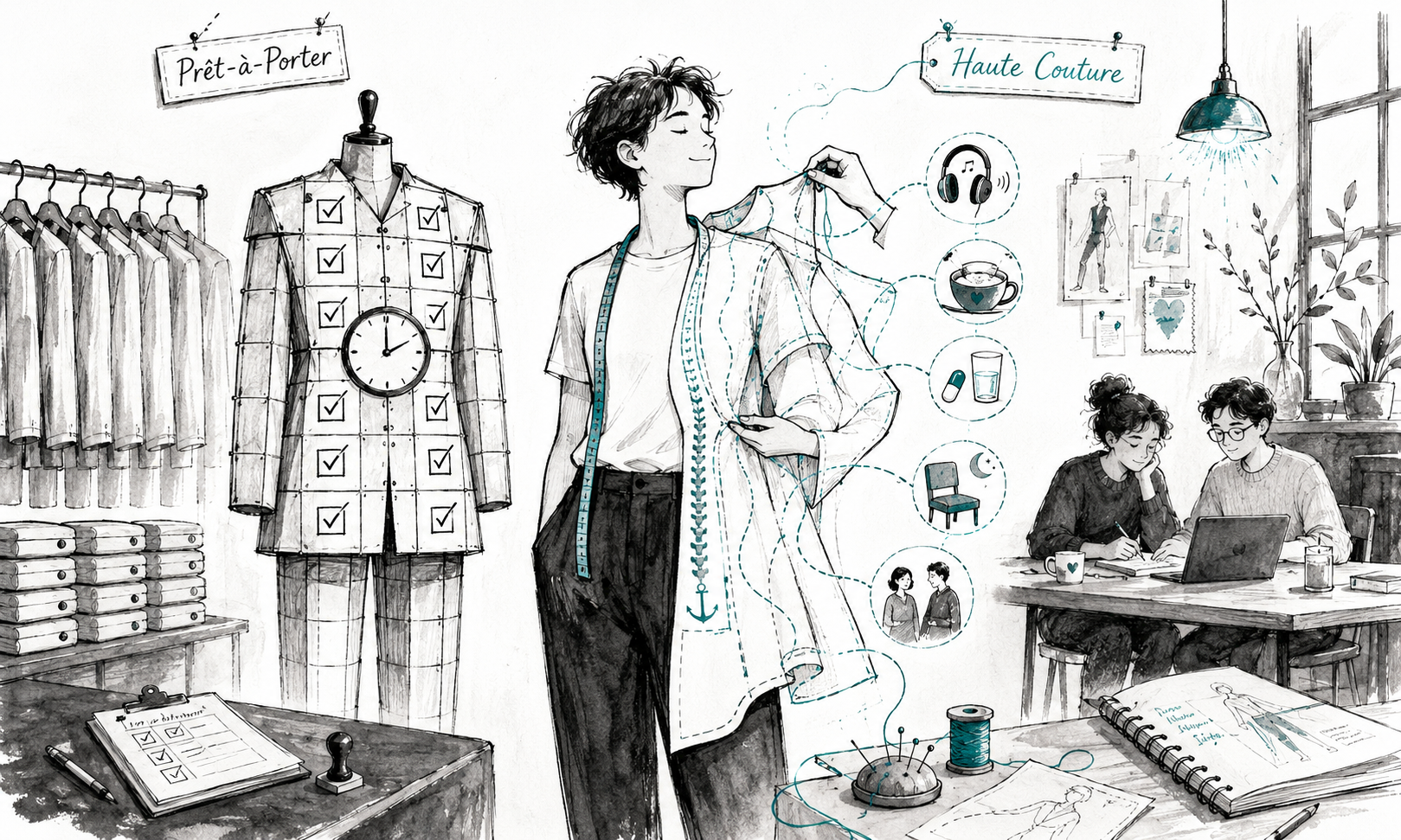
Advice about routines often arrives as Prêt-à-Porter: ready-made, standard-sized and designed for an imagined average person.
Wake at 6:30am. Exercise. Eat the same breakfast. Work in timed blocks. Reward yourself when everything is finished. Repeat until it becomes automatic.
For many AuDHD people, this approach fails — not because they lack discipline, but because the routine was never cut for their nervous system.
A more supportive routine is closer to Haute Couture. It is built around the wearer: their sensory profile, attention patterns, transition costs, responsibilities, interests, health and fluctuating capacity. It may contain familiar structural elements, but their placement, weight and fit are individual.
The aim is not to force an AuDHD person into a routine. It is to design a routine they can inhabit.
One nervous system, not two competing halves
A common shorthand says:
- “The autistic part wants routine; the ADHD part wants novelty.”
This can describe a recognisable tension, but it should not be taken literally. Autism and ADHD do not occupy separate halves of the brain or alternate control of behaviour. They form one integrated and highly individual neurodevelopmental profile. Research finds overlapping, varied and sometimes distinct executive-function patterns across autism and ADHD rather than a simple neurological tug-of-war.
Autistic processing may favour predictability because familiar patterns reduce uncertainty, sensory surprise, decision-making and transition labour. ADHD-related attention and motivation may be more readily mobilised by novelty, urgency, immediate feedback or personal interest.
Both tendencies can exist simultaneously:
- wanting plans but resisting being controlled by them;
- needing predictability but becoming under-stimulated by repetition;
- seeking novelty and then becoming overwhelmed by its sensory and transition costs;
- creating elaborate systems but struggling to re-enter them after one interruption;
- hyperfocusing past bodily limits and then needing extended sameness and withdrawal.
It may be more accurate to think in terms of neurological affordability.
Novelty, urgency or interest can temporarily make action affordable. The person may mobilise considerable attention and effort, sometimes without noticing hunger, fatigue, pain or accumulating sensory load. Afterwards, their remaining capacity for switching, improvising, masking and tolerating unpredictability may be reduced.
What looks like “autism taking over” may therefore be a whole nervous system relying on lower-cost defaults after an expensive period of activation.
This is an evidence-informed clinical formulation, not a proven model of alternating “ADHD mode” and “autistic mode”. What is well established is that autistic burnout can involve profound exhaustion, loss of functioning and reduced tolerance of sensory input, particularly when demands repeatedly exceed available support and recovery.
Why Prêt-à-Porter routines often fail
A ready-made routine assumes that the same activities cost roughly the same amount each day.
For an AuDHD person, the cost of an activity may vary according to:
- sleep and physical health;
- sensory conditions;
- hormonal changes;
- social exposure;
- pain and interoceptive access;
- the number of transitions involved;
- whether the task is chosen or imposed;
- uncertainty about what “finished” means;
- current interest and reward salience;
- what internal context or train of thought must be interrupted and later reconstructed;
- how much masking or emotional regulation has already been required.
“Send one email” might be nearly effortless one day and require an hour of preparation on another. “Go to the gym” may include finding clothes, changing sensory state, travelling, entering a socially complex space, switching activities, tolerating noise, showering and returning home.
A generic routine counts the visible task.
A tailored routine counts the whole cost.
Before redesigning a routine, it is also worth asking whether the goal itself is yours. A perfectly engineered system can still become a form of compliance if it helps you perform an expectation you would not otherwise choose. The question is not only “How can I make this achievable?” but “Why am I trying to achieve it?
That whole cost includes cognitive displacement. A brief demand may interrupt a complex internal model, emotional process or chain of association that cannot be resumed automatically. The visible task may take five minutes while recovering the previous cognitive position takes much longer.
Before optimising a routine, it is worth asking whether the underlying goal is actually yours. A routine can be perfectly adapted to your nervous system and still become a sophisticated form of compliance if it helps you meet an expectation you would not otherwise choose.
The questions are therefore not simply:
- “How do I make myself do this every day?”
but:
- “Is the underlying goal still mine?”
- “If it is, what design would make returning to this behaviour sufficiently affordable on different kinds of days?”
Build a rhythm rather than a rigid routine
A rhythm preserves continuity without demanding identical performance.
Habit research supports repeating behaviours in stable contexts so that cues can gradually carry some of the initiation load. The cue does not always need to be a precise clock time; it may be a place, preceding event or recognisable sequence.
In AuDHD, automaticity can reduce the executive load of a familiar action, but the capacity it frees does not necessarily remain available for that action. Attention may be redirected towards whatever is most novel, emotionally salient, unresolved or associatively linked. This is why a familiar routine may make initiation easier without guaranteeing that attention will remain attached to the sequence.
For example:
- after waking, drink water and take medication;
- after the first work block, eat;
- after returning home, decompress before conversation;
- after feeding the cat, prepare for bed.
The anchor remains recognisable even when the exact time or size of the activity changes.
A supportive AuDHD rhythm has fixed architecture and variable load.
Automatic routines may free foreground attention rather than quiet the mind
Someone may walk a familiar route, wash dishes or fold clothes competently while their foreground attention is engaged in complex analysis or associative thinking.
This can produce an unusual combination: reliable automatic movement alongside missed details; intense thought alongside apparent distractibility; and competent routine performance that becomes fragile when interrupted.
The external and internal activities may depend on different forms of cognition. The familiar external sequence may rely more heavily on procedural memory and low-level monitoring: what comes next, where something belongs and whether the sequence is complete. The internal task may involve associative or integrative cognition: maintaining a conceptual model, following a long chain of thought or holding several perspectives together.
These are descriptive modes of cognitive engagement, not separate anatomical systems, and they may overlap or alternate rapidly.
An interruption can therefore create what I think of as a double reconstruction problem. The person must recover both their place in the external sequence and the internal structure that had been developing. What appears to be resistance to a small task may sometimes be an attempt to avoid losing a cognitively expensive state.
A supportive routine should not merely automate behaviour. It should help the person decide what can safely run in the background, protect valuable trains of thought, and make returning to either layer easier.
Not every task is equally suitable for autopilot. Folding familiar laundry may coexist safely with reflective thought, while medication, cooking with heat, driving or consequential communication require more deliberate supervision.
Construct the daily spine
The spine consists of activities necessary for health, safety, immediate responsibilities and sustainable functioning.
It might include:
- medication;
- food and hydration;
- essential personal care;
- caring for children, animals or dependent adults;
- urgent work or administrative responsibilities;
- preparation for sleep;
- protected recovery.
The spine should be small enough to survive a genuinely difficult day. If it contains a full idealised productivity schedule, it is no longer a spine.
Each essential can have several fits.
Minimum fit
The smallest version that protects basic functioning.
- Eat accessible food.
- Brush teeth.
- Reply only to the urgent message.
- Walk outside for five minutes.
- Put medication and water beside the bed.
Everyday fit
The ordinary version for a moderate-capacity day.
- Prepare a simple meal.
- Shower.
- Complete one focused work block.
- Take a short walk.
- Clear one functional area.
Expanded fit
The version available when more capacity is available.
- Batch cook and prepare food for a few days.
- Complete the full personal-care routine.
- Exercise for longer.
- Tackle a demanding project.
- Organise several areas.
This is not a hierarchy of better and worse functioning. It is graded access, built into the garment so that it remains wearable as capacity changes.
Separate essentials, optionals and nourishment
Once the spine is clear, other activities can be divided into two broad layers.
Optional activities
These matter, but their timing, dose or method can vary.
They may include:
- routine administration;
- housework beyond immediate hygiene or safety;
- shopping;
- non-urgent communication;
- exercise above the minimum;
- longer creative or professional tasks.
“Optional” does not mean trivial. It means contingent on available sensory, executive, social and physical capacity.
Nourishing activities
These provide pleasure, meaning, curiosity, connection or regulation:
- special interests;
- music;
- reading;
- games;
- films;
- making things;
- nature;
- enjoyable movement;
- low-demand social contact.
Calling these “extras” can create a life consisting only of survival and maintenance. Nourishment is part of sustainable functioning.
However, pleasure and rest are not identical. A special interest may be joyful and still lead to six hours of hyperfocus, missed food and reduced sleep. A social occasion may be meaningful and require two days of recovery.
The useful question is not only:
- “Did I enjoy it?”
It is also:
- “What did it cost, and how did I feel afterwards?”
Put rest into the spine
Rest should not sit at the bottom of the list, available only after everything else is complete.
Autistic burnout research repeatedly identifies reduced demands, solitude, sensory relief, support and permission to function in autistic ways as important to prevention and recovery.
Rest is not one particular activity. It means reducing the type of load that is currently excessive.
- Sensory rest: darkness, quiet, headphones, familiar textures.
- Social rest: solitude or companionship without conversation.
- Executive rest: no decisions, deadlines or sequencing.
- Cognitive rest: familiar or otherwise low-demand input that does not require effortful processing.
- Physical rest: sleep, lying down or gentle movement.
- Rest from imposed demands: doing something simply because you choose it and it appeals.
For some people, rest includes a film, a walk or a special interest. For others, those activities are still too demanding.
Rest is defined by its regulatory effect, not by whether it looks inactive.
Regulate the task-state
“Make the task interesting” is imprecise advice.
A 2026 review found that non-autistic people with ADHD reported heightened sensitivity, reduced registration, sensory seeking and avoidance across different sensory domains. This makes “add stimulation” or “remove distractions” too crude as general advice. The useful sensory conditions may differ by channel, activity, environment and day. Because autistic participants were excluded, the review cannot define an AuDHD-specific sensory profile, but it strengthens the ADHD side of this formulation.
Music, movement, fidgeting, chewing or predictable sound may help some people reach and maintain a workable level of activation. They may provide rhythm, mask irregular environmental noise or occupy an attention channel that would otherwise seek stimulation elsewhere.
But additional input can also compete with the primary task or create sensory overload.
The aim is not maximum stimulation. It is the right type and dose of stimulation for this person, this task and this day.
Some repetitive, low-risk activities may also support thinking. Walking, folding laundry, familiar crafts or simple domestic tasks can provide enough bodily rhythm to sustain associative or reflective cognition. This can be designed deliberately, provided the external task is safe to perform with reduced foreground supervision and there is a way to capture useful thoughts.
- Repetitive physical work may pair well with energetic music.
- Reading may require instrumental music, steady noise or silence.
- A tiring day may require less stimulation than usual.
- Movement may support listening but disrupt fine-motor work.
Judge the support by whether it improves initiation, persistence, accuracy and the after-effect—not merely whether the task feels more entertaining.
Use body doubling as ambient companionship
Body doubling involves completing a task in the presence of another person, physically or virtually. The other person may be doing the same task or something entirely different.
It can resemble adult parallel play: two people occupying shared space while following separate attentional tracks.
Research with neurodivergent participants describes body doubling as a continuum ranging from explicit accountability to low-demand ambient companionship.
The other person’s presence may provide:
- an initiation cue;
- a visible rhythm;
- a beginning and end;
- gentle accountability;
- emotional containment;
- reduced isolation;
- companionship without conversational demand.
In lived-experience language, it may feel like basking in one another’s presence.
The helpful ingredient is not simply another body. Body doubling may be most helpful when the person feels safe, unjudged and free from unnecessary interruption. Supervision, pressure or mood-monitoring may increase rather than reduce task cost.
Externalise time, intention and re-entry
Timers, reminders and scheduling cues should not be treated as interchangeable.
A timer externalises duration:
- How long have I been doing this?
- When is the break?
- When should I stop?
A reminder retrieves an intention:
- What was I supposed to do?
- What needs to happen today?
An action cue supports transition:
- Save the document now.
- Put on shoes.
- Leave the house.
- Start preparing for bed.
A reminder that says “appointment at 11” may not generate the sequence required to arrive there. A supportive system might include:
- 10.00: finish current task;
- 10.10: eat and use the bathroom;
- 10.25: gather belongings;
- 10.35: put on shoes;
- 10.40: leave.
The purpose is not to impose more alarms. It is to place time, intentions and sequence outside working memory. External support can also protect both sides of an interruption: a checklist preserves the physical routine, while a brief note, voice memo or open document preserves the internal train of thought. A useful cue does not merely say what time it is; it shows what to do next and where to return afterwards.
Before leaving complex work, record the active question, the current conclusion and the smallest next step. This creates a cognitive bookmark rather than requiring the whole mental structure to be rebuilt later.
Use rewards carefully
Immediate reinforcement can improve ADHD task engagement, but rewards are not universally benign. Reward effects vary according to timing, task, personal meaning and whether the reward feels informative or controlling. Research also raises concerns that external incentives may undermine intrinsic motivation under some conditions, particularly when an already enjoyable activity becomes something performed mainly for a promised reward.
Instead of withholding all pleasure until completion, place support inside the process.
Rather than:
- “Finish cleaning, then you may listen to music.”
Try:
- “Use music to support cleaning.”
Rather than:
- “Complete the report, then have tea.”
Try:
- “Make tea, settle with a body double and begin with the smallest section.”
This shifts pleasure from a ransom payment for productivity to part of the task’s supportive architecture.
Rewards may still help when they are immediate, reliable and meaningful, particularly for tasks with little intrinsic attraction. But they should not become the only route through which action feels accessible.
Expect to restart without shame
AuDHD routines are often cyclical. Illness, travel, hormonal change, sensory overload, burnout, competing demands or loss of novelty may interrupt them.
A lapse is not evidence that previous learning has disappeared. Nor is it a character reference.
The useful question is not:
- “Why can I never stick to anything?”
It is:
- “What interrupted access to this routine?”
Possible answers include:
- the minimum version was still too large;
- the cue was too weak;
- the task depended on remembering rather than environmental support;
- the sensory cost changed;
- the routine required too many transitions;
- the person overspent during a high-activation period;
- the method never fitted the goal.
Self-validation does not mean declaring every choice effective. It means acknowledging that a reaction has a context before evaluating what must change.
Shame says:
- “The routine failed because I am defective.”
Accountability says:
- “The routine became inaccessible. What does that tell me about its design, and what will I change?”
Know when not to restart
Haute Couture includes alterations — and sometimes deciding that a garment no longer belongs in the wardrobe.
Not every abandoned routine should be revived. The person may need to:
- resume it after an interruption;
- reduce the dose;
- redesign the method;
- pause until conditions improve;
- release a goal that no longer justifies its cost.
Past investment is a sunk cost. Time, money or effort already spent may provide useful information, but it should not obligate further expenditure.
Ask:
- Is the underlying goal still mine?
- Does the purpose fit, even if the method does not?
- Is this a temporary disruption or a repeated mismatch?
- Can one adjustment reduce the cost?
- What does completing it displace?
- Would I choose to begin this today, knowing what I know now?
Restarting is a skill. Stopping wisely is another.
The Haute Couture routine
A supportive AuDHD routine is not built around perfect consistency. It is designed around re-entry.
It has:
- a small daily spine;
- minimum, standard and expanded versions;
- event-based anchors;
- external reminders and action cues;
- sensory supports selected by task and capacity;
- body doubling where companionship helps;
- pleasure inside the process;
- protected recovery;
- cognitive bookmarks that preserve context across interruptions;
- permission to alter or release poor-fit goals.
Prêt-à-Porter routines organise visible behaviour. Haute Couture routines also account for capacity, transition cost and where foreground attention goes while the behaviour is happening.
Haute Couture asks:
- “What does the routine need to become so that it fits your nervous system?”
The best routine is not the most disciplined-looking one. It is the one that protects essential functioning, accommodates changing capacity and remains easy enough to return to without shame.
Keep the structure recognisable. Vary the dose. Protect what sustains life, include what makes life worth sustaining, and tailor the routine until it can be worn rather than endured.
The information in this article is provided for general psychoeducational purposes only. It is not therapy, clinical advice, diagnosis, or a substitute for working with a qualified professional, and it should not be relied on as such. Any examples are illustrative and may not apply to your individual circumstances. If you are considering making changes to your health, wellbeing, relationships, work, or care, seek appropriate professional support tailored to you.
To the fullest extent permitted by law, we accept no responsibility or liability for any loss, harm, or outcome arising from reliance on the contents of this article. If you are in immediate danger or feel unable to keep yourself safe, contact emergency services or your local crisis support line straight away.