When possible rejection feels like danger — and how to recover enough capacity to find out what actually happened
Published 09 July 2026
12-minute read
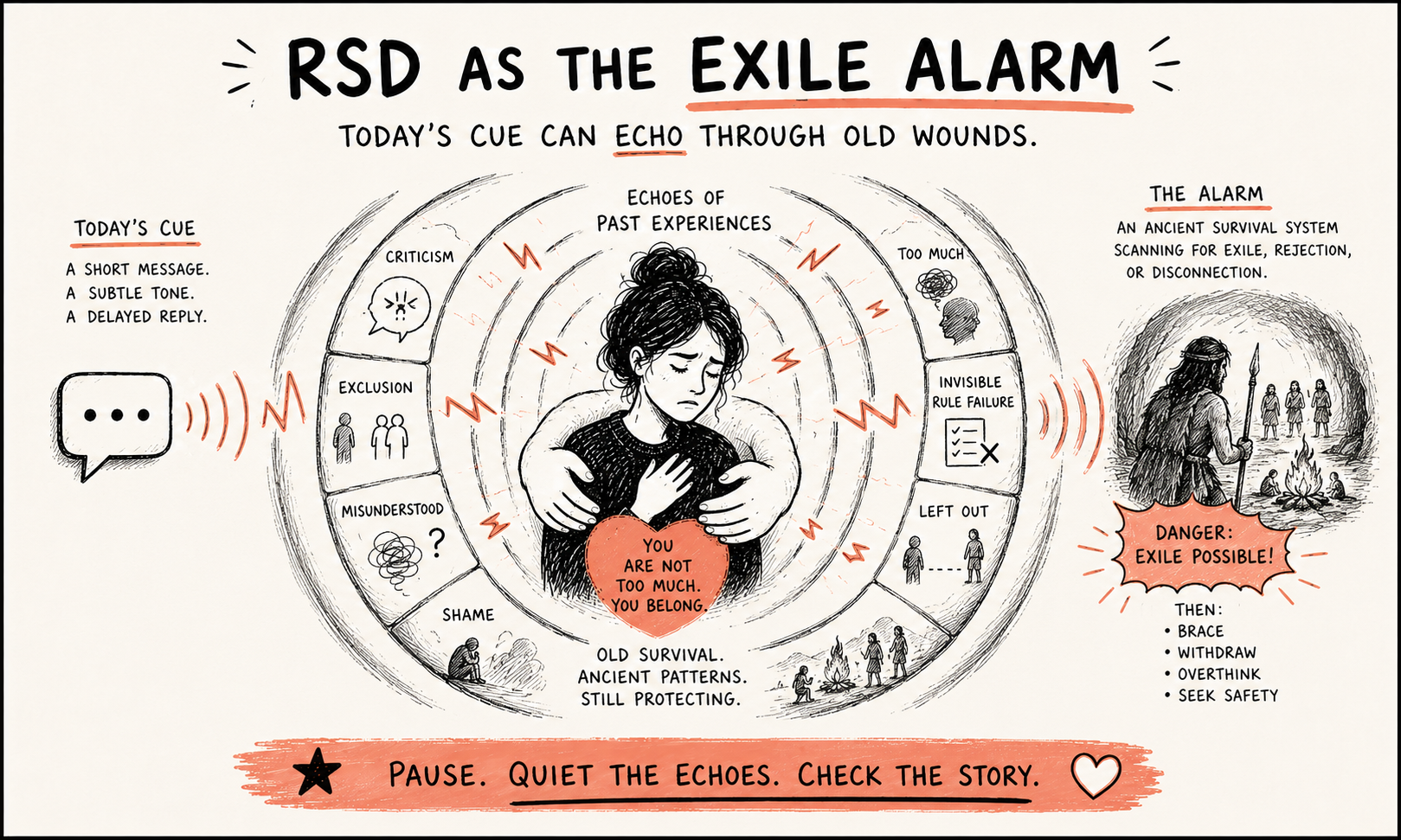
Most people dislike rejection. But for some people, criticism, exclusion, disapproval or even ambiguity can land not as ordinary disappointment but as shock: a stomach drop, heat, nausea, blankness, rage, shame, collapse, or a sudden conviction that something has gone badly wrong.
Rejection sensitivity is an established psychological construct describing a tendency to anxiously expect, readily perceive and react strongly to rejection. “Rejection sensitive dysphoria”, or RSD, is a less formal term commonly used in ADHD and neurodivergent communities for particularly intense rejection-related states. It is not a formal diagnosis, and research into RSD as a distinct phenomenon is still emerging.
That emerging research matters. Autistic adults interviewed in a 2025 qualitative study described rejection sensitivity as overwhelming and exhausting, sometimes accompanied by physical tension, pain and the re-emergence of earlier rejection experiences. A small 2026 ADHD study similarly found withdrawal, masking and striking bodily sensations, including nausea, heat, chest or throat sensations and paralysis-like experiences. These studies do not establish how common RSD is or prove a single mechanism, but they support what many people have been saying for years: rejection can be experienced as a whole-body event.
A useful working formulation is:
RSD can feel like an old belonging alarm amplified by lived experience.
Why rejection can feel like danger
Belonging is not decorative. Human beings are social mammals, and social connection has carried survival value throughout our evolutionary history. Research on “social pain” also suggests some overlap between the affective and neural processes involved in social rejection and physical pain, although the two are not neurologically identical.
That does not prove that RSD is an evolved “exile system”. I use the idea as a formulation rather than a settled biological mechanism. It helps explain why a cue that looks small from the outside can produce an enormous internal response.
A delayed reply may be only a delayed reply. But the nervous system may have learnt that silence precedes exclusion.
A changed tone may be fatigue. But it may resemble the tone that used to arrive before criticism.
“Can we talk?” may be an ordinary request, while the body hears: I am in trouble.
The present cue therefore does not always land alone. It may arrive carrying the weight of earlier experience.
For neurodivergent people, this can be particularly potent. Many have spent years encountering social rules that seemed obvious to others but remained invisible until after they had supposedly broken them. Repeated correction, bullying, exclusion, being misunderstood, having one’s tone judged, or discovering retrospectively that an unspoken rule existed can teach a difficult lesson:
Other people may know I have failed before I know what the rule was.
This is one reason ambiguity can be harder than clear criticism. Clear information creates a possible route to understanding, repair or disagreement. Ambiguity creates alarm without a map.
Shame's sibling: the hidden accusation
One clinical distinction I find useful is between shame and rejection sensitivity.
- Shame may say:
“I know what is wrong with me, and I am afraid you will discover it.” - Rejection sensitivity may sound more like:
“Something has changed. You seem to know something bad about me that I do not know yet. I need to find it and correct it before I am rejected.”
That can create a feeling of being on trial without knowing the charge.
A partner goes quiet. A colleague becomes brief. Someone hesitates before answering. A friend does not respond. The mind begins trying to close the information gap at speed.
That attempt is not necessarily irrational. Sometimes rejection really is happening. Sometimes somebody is angry. Sometimes harm has occurred.
The important distinction is not between real feeling and imaginary feeling.
It is between what is already known and what has not yet been established.
The pain is real; the verdict may be premature.
Premature does not mean wrong. Regulation is not a method for persuading yourself that nothing happened or that your perception cannot be trusted. It is a way of recovering enough capacity to ask more accurately:
Was this ambiguity, current rejection, an echo of previous experience, or some combination of all three?
The affective footprint
Alexander Luria's early work on affect offers a useful historical image. His combined motor experiments examined how emotionally significant material could disrupt speech, movement and organised responding even when the person was not simply verbalising the underlying affect.
I think of this as an affective footprint.
- A partner saying “not now” may become:
I am unwanted. - A manager asking for a meeting may become:
I am about to be fired. - A friend not replying may become:
I have been dropped.
The point is not that these interpretations are automatically false. The point is that the present cue and the meaning attached to it are not the same thing.
The recent autistic study is particularly interesting here: participants described not only strong current reactions but reliving previous rejection. Today's cue can therefore acquire intensity from yesterday's experience.
Why RSD is often discussed with ADHD
Rejection sensitivity is not exclusive to ADHD, and RSD is not an ADHD diagnostic criterion. However, emotional dysregulation is well documented in adults with ADHD. A meta-analysis of 13 studies involving 2,535 participants found substantially greater emotion dysregulation in adults with ADHD than in controls.
That may help explain why rejection-related states can become very rapid and intense for some ADHD people. But it does not justify treating every strong reaction to criticism as RSD, or every RSD-like state as evidence of ADHD.
Timing can provide useful information. A rejection-sensitive spike is often closely linked to a perceived social event and may rise very quickly. A sustained mood episode tends to involve broader changes in mood, energy, sleep, behaviour and functioning over a longer period.
This is not a diagnostic shortcut. ADHD, autism, trauma, anxiety, OCD, depression, bipolar disorder and other difficulties can overlap.
When avoiding rejection begins to author a life
The acute pain is only part of the problem. Rejection sensitivity can gradually organise behaviour around preventing the alarm from firing.
Someone may become agreeable, making themselves useful, undemanding and easy to keep; perfect, trying to become impossible to criticise; avoidant, not applying, asking, dating, creating or initiating; defensive, attacking or rejecting before rejection can arrive; or absent, withdrawing or leaving before they can be left.
Emerging ADHD research has specifically described masking and withdrawal around rejection sensitivity. Autistic adults have also described the cumulative effect of lifelong experiences of rejection.
These strategies can be understandable and still become expensive.
Eventually the question is no longer simply:
How do I stop feeling this much?
It may become:
How much of my life is being chosen by me, and how much is being chosen by the need not to be rejected?
A person may appear to be choosing the agreeable answer, the safe career, silence, perfectionism or staying in a relationship, while the organising question underneath has become:
Which option is least likely to get me rejected?
A useful counter-question is:
What might I choose if rejection felt survivable?
What happens in an acute RSD spike
A useful simplified sequence is:
cue → body alarm → interpretation → emotion → protective action
Imagine receiving an email from a manager:
“Can we talk tomorrow?”
The stomach drops. The chest tightens. The mind rapidly supplies an explanation:
I am in trouble. I have failed. They know something.
Shame or panic arrives. The person spends the evening rehearsing, checking messages, trying to obtain reassurance, writing explanations or imagining resignation.
At high levels of affect, cognition becomes more expensive. Working memory, language, flexibility, proportion and the ability to hold several explanations at once may all become harder to access.
This is exactly when people are often told to “just think rationally”.
A more useful immediate aim is enough capacity to think again.
Where it is safe to wait, postpone high-stakes action until more of that capacity has returned. Regulation cannot tell you whether the other person has rejected you. It can make enquiry possible.
Reduce load. Restore capacity. Return with choice.
Different nervous systems need different routes back
There is no single correct RSD-regulation technique. The useful question is:
What reduces escalation for this nervous system?
For someone flooded or frozen, that may mean less input: less light, less noise, fewer words, no eye contact, putting the phone away, pausing the conversation, lying down, warmth or pressure.
“I am not ignoring this. I need less input before I can come back to it.”
For someone mobilised by anger, panic or adrenaline, stillness may increase distress. Movement — walking, pacing, stretching, swimming or another familiar safe activity — may be more useful.
Some people benefit from co-regulation: the presence of a calm, safe other.
“Can you stay near me without trying to solve this?”
Seeking co-regulation is not inherently a sign of dependency. Nor does it require another person to provide unlimited reassurance. The other person is allowed boundaries.
And some people regulate through speaking, provided the listener has capacity and the conversation does not become interrogation or repeated demands for certainty.
“Do you have ten minutes to let me talk this through? I am not asking you to fix it.”
A practical RSD plan
When rejection sensitivity spikes, consider five steps.
1. Name what is happening
“My body is reading rejection.”
Or:
“This feels like exile, but I do not yet know what it means.”
Naming the state is not dismissing it. It separates the existence of the alarm from certainty about its interpretation.
2. Postpone what is difficult to reverse
Where it is safe to wait, consider delaying the long message, resignation, breakup, global apology, confrontation or final judgement about yourself or the other person.
A temporary rule might be:
No irreversible decisions while the alarm is at full volume.
3. Reduce unnecessary load
Ask:
Do I need quiet? Movement? Another person nearby? Food? Water? Medication? Sleep? Pain relief? Warmth? Darkness? Fewer words?
The answer is individual.
4. Let the first wave be a body event
This is different from ruminating.
You do not have to solve the relationship while your system is using most of its available capacity to manage threat.
Sometimes it is enough to let the feeling exist without immediately requiring it to become explanation, decision or action.
5. Return to enquiry
When you can hold more than one possibility again, ask:
- What actually happened?
- What am I interpreting?
- What information is missing?
- Is this old pain, present harm, or both?
- Is clarification, reassurance, repair or a boundary needed?
This is also where responsibility becomes possible.
If something you did while flooded affected another person, their impact can be acknowledged without automatically accepting every interpretation of your motive or character.
New information can then inform afteraction: what, if anything, do you want to repair, change or do differently next time?
If you are supporting someone
The most useful response often combines steadiness with boundaries.
For example:
“I care about you. I am not making a judgement about the whole relationship from this one issue. We can come back to it when we both have more capacity.”
Or:
“I can reassure you that I am here. I cannot keep answering the same question until certainty appears.”
What usually adds load is ridicule, sarcasm, disappearing without explanation, forcing immediate analysis, or requiring the person to prove that their reaction is reasonable while they are flooded.
But support does not mean agreeing with every interpretation.
Nor does loving someone mean taking responsibility for ensuring that they never experience rejection, uncertainty or disappointment.
Both people remain people.
Safety matters
Intense rejection-related states can sometimes include severe self-attack, urges to disappear, self-harm thoughts, dangerous impulsivity or suicidal thinking. Those experiences should be taken seriously rather than dismissed as “just RSD”.
Likewise, not every intense emotional state should automatically be attributed to rejection sensitivity. Persistent depression, unusually elevated or agitated mood, markedly reduced need for sleep, psychosis, severe functional deterioration or dangerous impulsivity warrant appropriate clinical assessment.
A less moral way to understand rejection sensitivity
The useful formulation is not:
“You are too sensitive.”
Nor is it:
“Your perception is wrong because you have RSD.”
It is closer to:
“Your nervous system may be treating possible rejection as urgent danger. Let us understand the alarm before deciding what the alarm means.”
Sometimes the answer will be that nothing catastrophic happened.
Sometimes somebody genuinely rejected, misunderstood or harmed you.
Sometimes old pain and present harm are both involved.
The aim is not to train yourself out of caring about belonging. Nor is it to become endlessly tolerant of rejection.
It is to preserve enough of yourself during the alarm that you can still investigate, decide and act.
Sensitivity does not have to disappear for agency to increase.
The goal is to become less exiled from yourself when rejection is activated.
The information in this article is provided for general psychoeducational purposes only. It is not therapy, clinical advice, diagnosis, or a substitute for working with a qualified professional, and it should not be relied on as such. Any examples are illustrative and may not apply to your individual circumstances. If you are considering making changes to your health, wellbeing, relationships, work, or care, seek appropriate professional support tailored to you.
To the fullest extent permitted by law, we accept no responsibility or liability for any loss, harm, or outcome arising from reliance on the contents of this article. If you are in immediate danger or feel unable to keep yourself safe, contact emergency services or your local crisis support line straight away.